Specifications are collected from official manufacturer websites. Please verify the specifications before proceeding with your final purchase. If you notice any problem you can report it here.
I would also like to add my two cents about this product, because there are quite a few reviews with speedtests showing 300–500+ Mbps that may create the wrong expectations.
TL;DR: If you are looking for stable speeds of 250 Mbps+ in an urban/suburban area, this antenna is not for you. The tests showing such speeds are usually done at dawn, when the tower is empty or if the tower has no load at all in some area, which is impossible to know without trying it with one of these devices. During peak hours you will see 100–150 Mbps.
This antenna has a parabolic shape, designed for maximum gain over long distances. It is ideal for last-mile deployments, houses in the mountains or remote areas with the nearest base station 10+ km away, where without an external antenna you get 10–20 Mbps on your mobile. In these cases, the LHG can give you 80–100 Mbps, which is just fine for a house with Netflix and browsing.
However, if you are in a city or suburb with a base station 2–5 km away, you will gain almost nothing compared to a simpler solution.
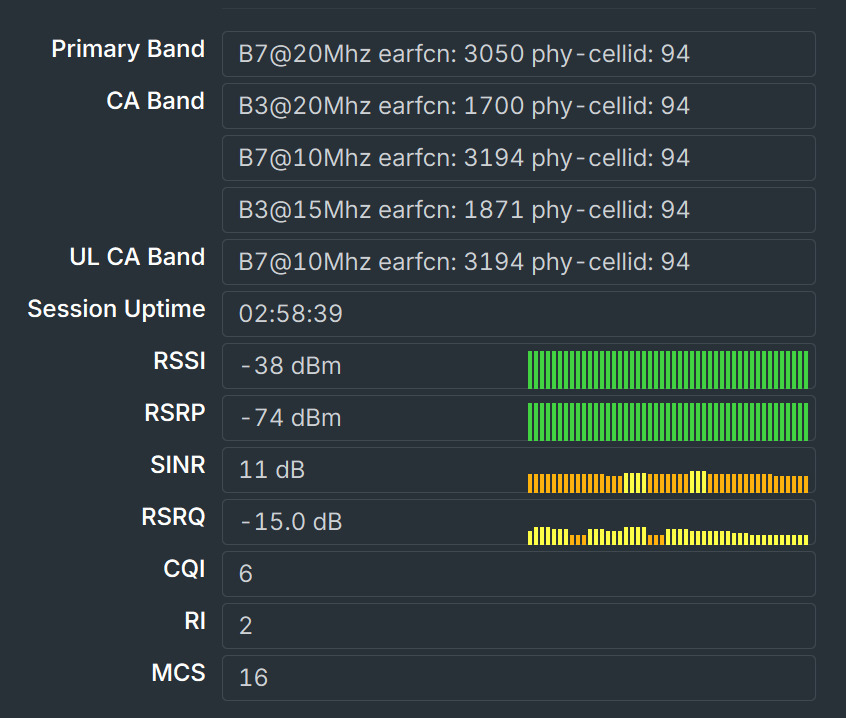
My own experience with the antenna, I am 2.2 km from the tower, with excellent signal:
RSRP: –74 dBm (excellent)
SINR: 11 dB
Full 4CA aggregation: B7@20 + B3@20 + B7@10 + B3@15 MHz (65 MHz total bandwidth)
Nevertheless, in the speedtest I get only ~100 Mbps download. Essentially, my antenna is "shouting in the ear," but the tower is distributing the bandwidth to dozens of users simultaneously.
The proof that the problem is not the tower came when I bought the MikroTik 5G ATL R16.
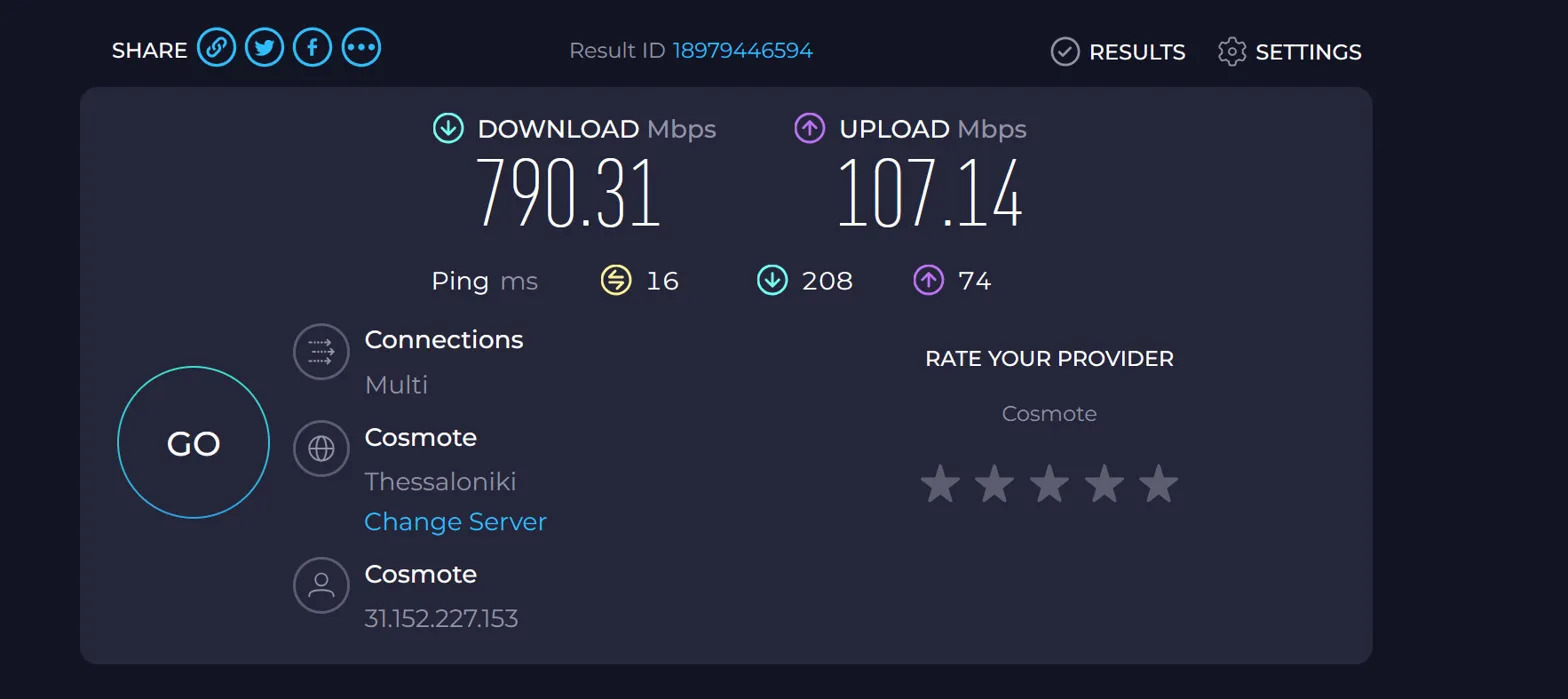
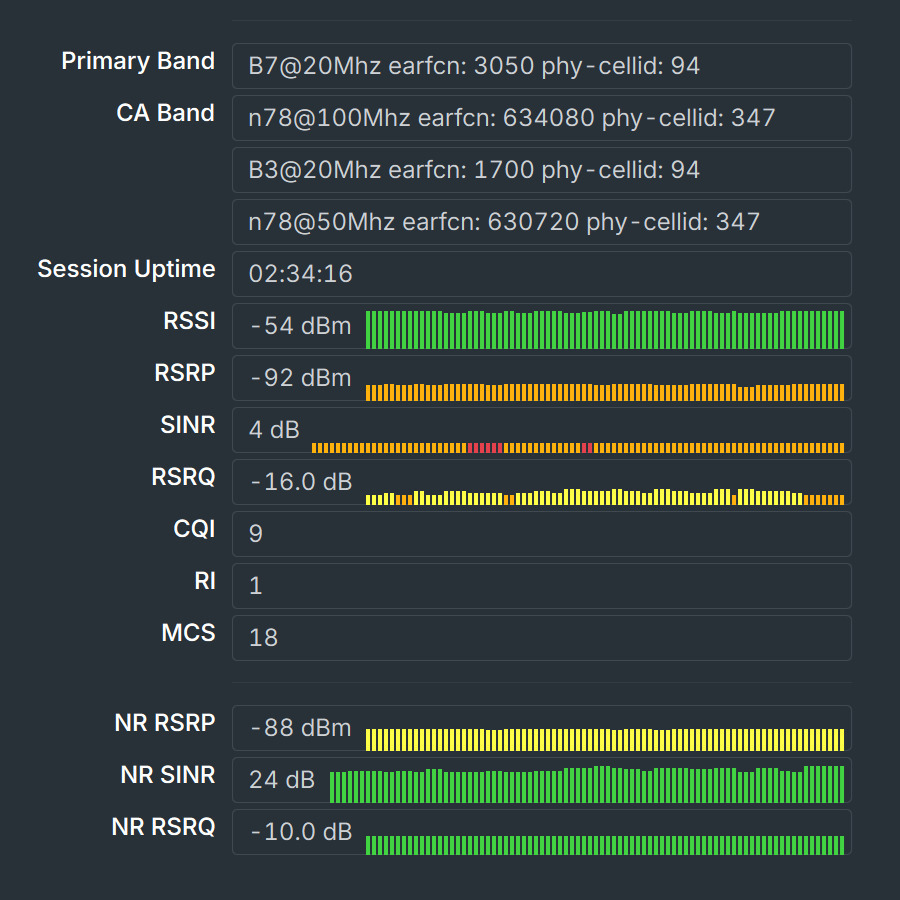
On the exact same tower (phy-cellid 94), I get 790 Mbps download and 107 Mbps upload. The 5G device aggregates n78@100 MHz + n78@50 MHz along with the LTE bands, and utilizes bandwidth that the LHG cannot see due to the 2x2 MIMO and the fact that it is exclusively LTE.
This proves that the tower can handle it, the bottleneck is the antenna itself and the fact that LTE 4G is now overloaded.
The LHG LTE18 is an excellent tool for what it was designed for: long-range connection in rural/remote areas. If your nearest tower is 10+ km away, it will work wonders.
But if you are in a city/suburb and expect 300+ Mbps because you saw it in some review, take a look at the ATL models with 4x4 MIMO, or even better, the 5G models if your tower supports NR. The difference is dramatic.
Θα ήθελα να βάλω κι εγώ το λιθαράκι μου για αυτό το προϊόν, γιατί υπάρχουν αρκετές αξιολογήσεις με speedtests που δείχνουν 300–500+ Mbps και μπορεί να δημιουργήσουν λάθος προσδοκίες.
TL;DR: Αν ψάχνετε σταθερές ταχύτητες 250 Mbps+ σε αστική/προαστιακή περιοχή, αυτή η κεραία δεν είναι για εσάς. Τα tests που δείχνουν τέτοιες ταχύτητες γίνονται συνήθως τα ξημερώματα, όταν ο πύργος είναι άδειος ή αν ο πύργος δεν έχει καθόλου φόρτο σε κάποια περιοχή πράγμα που είναι αδύνατο να ξέρετε χωρίς να το δοκιμάσετε με κάποια από αυτές τις συσκευές. Σε ώρες αιχμής θα δείτε 100–150 Mbps.
Η κεραία αυτή έχει παραβολικό σχήμα, σχεδιασμένο για μέγιστο gain σε μεγάλες αποστάσεις. Είναι ιδανική για last-mile deployments, σπίτια στα βουνά ή απομακρυσμένες περιοχές με τον κοντινότερο σταθμό βάσης στα 10+ km, που χωρίς εξωτερική κεραία πιάνουν 10–20 Mbps στο κινητό. Σε αυτές τις περιπτώσεις η LHG μπορεί να σας δώσει 80–100 Mbps, που για ένα σπίτι με Netflix και browsing είναι μια χαρά.
Αν όμως βρίσκεστε σε πόλη ή προάστιο με σταθμό βάσης στα 2–5 km, δεν θα κερδίσετε σχεδόν τίποτα σε σχέση με μια πιο απλή λύση.
Η δική μου εμπειρία με την κεραία, βρίσκομαι 2.2 km από τον πύργο, με εξαιρετικό σήμα:
RSRP: –74 dBm (άριστο)
SINR: 11 dB
Full 4CA aggregation: B7@20 + B3@20 + B7@10 + B3@15 MHz (65 MHz συνολικό bandwidth)
Παρ' όλα αυτά, στο speedtest παίρνω μόλις ~100 Mbps download. Ουσιαστικά η κεραία μου «φωνάζει στο αυτί», αλλά ο πύργος μοιράζει το bandwidth σε δεκάδες χρήστες ταυτόχρονα.
Η απόδειξη ότι το πρόβλημα δεν είναι ο πύργος, ήρθε όταν αγόρασα την MikroTik 5G ATL R16.
Στον ίδιο ακριβώς πύργο (phy-cellid 94), πιάνω 790 Mbps download και 107 Mbps upload. Η 5G συσκευή κάνει aggregate n78@100 MHz + n78@50 MHz μαζί με τα LTE bands, και αξιοποιεί bandwidth που η LHG δεν μπορεί να δει λόγω του 2x2 MIMO και του ότι είναι αποκλειστικά LTE.
Αυτό αποδεικνύει πως ο πύργος αντέχει, το bottleneck είναι η ίδια η κεραία και το γεγονός ότι το LTE 4G πλέον είναι υπερφορτωμένο.
Η LHG LTE18 είναι εξαιρετικό εργαλείο για αυτό που σχεδιάστηκε: long-range σύνδεση σε αγροτικές/απομακρυσμένες περιοχές. Αν ο πλησιέστερος πύργος σας είναι 10+ km μακριά, θα κάνει θαύματα.
Αν όμως είστε σε πόλη/προάστιο και περιμένετε 300+ Mbps επειδή το είδατε σε κάποιο review, ρίξτε μια ματιά στα ATL μοντέλα με 4x4 MIMO, ή ακόμα καλύτερα, στα 5G μοντέλα αν ο πύργος σας υποστηρίζει NR. Η διαφορά είναι δραματική.
The antenna was purchased to be installed in a cabin on a mountain at 1500 meters altitude.
The location is hard to reach, there is no spot with good and unobstructed visual contact with the antenna, and mobile phones only have signal in specific places.
I have directed it towards the antenna but there are trees blocking the way.
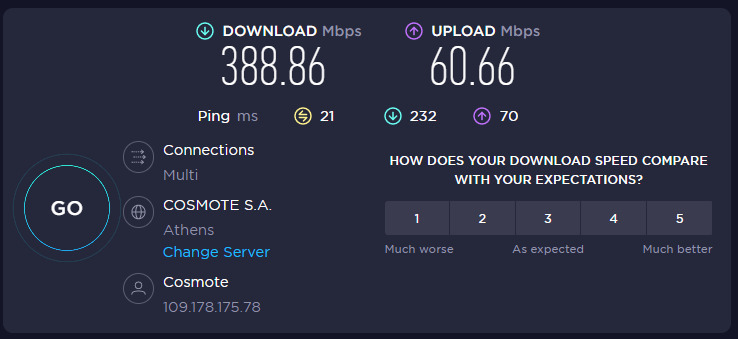
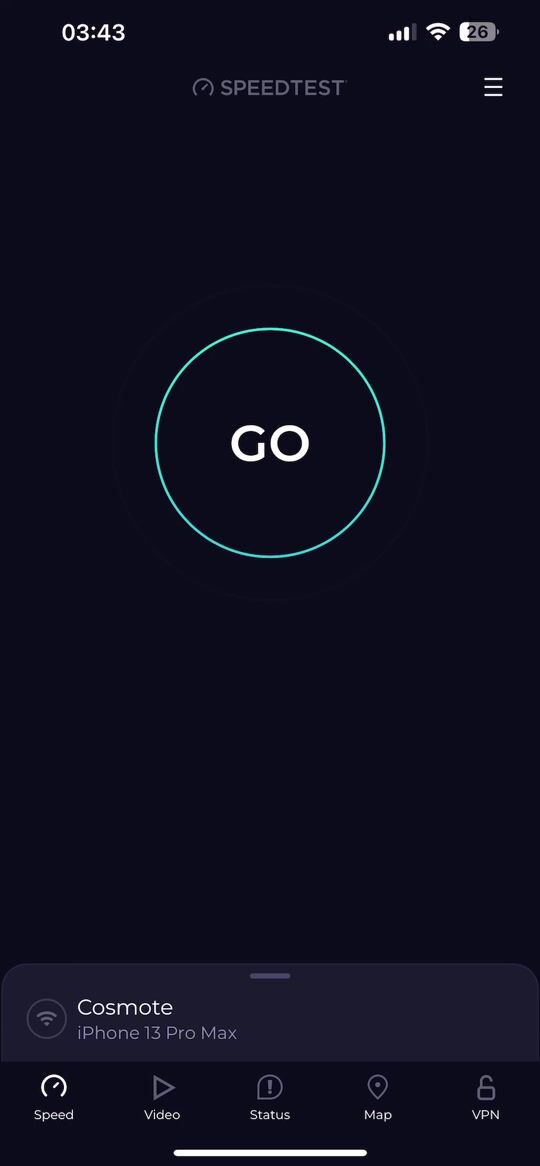
Nevertheless, I have a trouble-free internet connection with the speeds you can see in the photo!
I am very satisfied with the purchase and I highly recommend it for installation in areas with problematic coverage.
Η κεραία αγοράστηκε για να τοποθετηθεί σε καλύβι πάνω σε βουνό σε 1500 μέτρα υψόμετρο.
Η τοποθεσία είναι δυσπρόσιτη, δεν υπάρχει σημείο με καλή και ανεμπόδιστη οπτική επαφή με την κεραία και τα κινητά έχουν σήμα μόνο σε συγκεκριμένα σημεία.
Την έχω κατευθύνει προς την κεραία αλλά υπάρχουν δέντρα που εμποδίζουν.
Παρόλα αυτά έχω απροβλημάτιστη σύνδεση στο ίντερνετ με τις ταχύτητες που βλέπετε στην φωτογραφία!
Είμαι πολύ ευχαριστημένος με την αγορά και την συστήνω ανεπιφύλακτα για τοποθέτηση σε σημεία με προβληματική κάλυψη.
Summary Review:
(Read only this if you just want a quick opinion)
The Mikrotik LHG LTE18 is a very good option for a 4G LTE "antenna," especially when the signal strength in your area is insufficient for most devices. It is a high-quality construction, easy to install, with extremely advanced capabilities if you need them, stable operation, and most importantly, unbelievably fast speeds! I use it for gaming among other things. Compared to ADSL lines, it is much more stable, with no problems at any time. I highly recommend it, and I would also recommend an Unlimited Data Plan. ;)
- - - - - - - - - - - - - - - - - - -
Technical Information:
- Purchased on 11/15/2022
- Installed on a rooftop (see photo) in an area near Mesolongi.
- The provider I use is Cosmote.
- The Tower ID I connect to is: 102103 (for CellMapper)
- I use bands 1/3/7. (1 Main + 3CA)
- Currently, I have not purchased a corresponding router, so the LHG handles the routing.
- I use the latest RouterOS 7.6 (at that moment) with up-to-date RouterBoard + Modem firmware.
- - - - - - - - - - - - - - - - - - -
Detailed Description:
Advantages:
- The design with the dish enhancing the signal works very well, even in areas where you can't even get a phone signal! A strong and healthy signal is not only desirable for high speeds but also for a stable connection without interruptions or micro-disconnections.
- The LTE18 modem is extremely fast, with a maximum THEORETICAL speed of 1.2Gbps, while in realistic scenarios it is about half of that. This CLEARLY depends on your provider as well. The way the modem achieves these speeds is by combining different bands. It connects to more than one "transmitter" on the provider's antenna.
- Its installation is extremely easy if you have at least a screwdriver. It also depends on how you will mount it. USUALLY, the best solution is a mast or pipe with a diameter of 45-70mm. I would not recommend it on very thin pipes, as it may twist in the wind. (It comes with its own clamps, as well as an adapter for tilting up/down)
- It is powered via PoE, and the package includes an adapter and the necessary power supply. This means that you only need ONE cable from inside your house to the LHG.
- The device runs Mikrotik's firmware (or operating system, as I would call it), known as RouterOS, which has many, many features for almost every user. I am NOT EVEN the right person to explain them to you, but from what I have seen, if you think you need something, it PROBABLY already exists as a function! :D
Disadvantages:
I wouldn't say that this machine has any disadvantages per se, but it is worth mentioning that:
- It needs to be permanently installed somewhere outside. You also need to know where you "receive a signal" from. You can find this information on the CellMapper.com website. So, although the installation is not difficult at all, it takes a little time.
If, of course, the signal in your area is strong enough, then Mikrotik has another range of products, the "Chateau" Modem-Routers, also 4G LTE or even 5G. They are much easier to install and have extra capabilities.
- Its operating system, which I mentioned above, is extremely rich but a bit complex (I would say) for beginners users.
LUCKILY ( !!! )
a) It comes with a "pre-installed" Default Setup, which with a few adjustments (SIM PIN / APN etc.) works fine.
b) IF in the end, you need to change the setup, the community around these devices is very supportive and the documentation is quite rich.
c) There is also Greek content on YouTube, A-Z content about these devices, on the channel "Instatech PRO". You will definitely find valuable help.
d) I would recommend buying such devices from somewhere that offers support.
I hope I didn't tire you.
Happy shopping and happy surfing! ;)
Συνοπτική Αξιολόγηση:
(Διαβάστε μόνο αυτή, αν απλά θέλετε μια γρήγορη γνώμη)
Το Mikrotik LHG LTE18 είναι μια πολύ καλή πρόταση για "κεραία" 4G LTE, (ΚΥΡΙΩΣ) οταν η ισχύς του σήματος στην περιοχή σας δεν επαρκεί για τα περισσότερα μηχανήματα.
Πρόκειται για πολύ ποιοτική κατασκευή, εύκολη στην εγκατάσταση, με εξαιρετικά πολύπλοκες δυνατότητες αν τις χρειάζεστε, σταθερή λειτουργία, και το πιο σημαντικό, ασύλληπτα γρήγορες ταχύτητες ! Το χρησιμοποιώ, εκτός των άλλων, και για Gaming. Συγκριτικά με τις ADSL γραμμές, είναι πολύ πιο σταθερό, με μηδενικά προβλήματα σε οποιαοδήποτε καιρό.
Το προτείνω ανεπιφύλακτα, ενώ θα πρότεινα επίσης και ένα Unlimited Data Plan. ;)
- - - - - - - - - - - -
Τεχνικές Πληροφορίες:
- Αγοράστηκε 15/11/2022
- Τοποθετήθηκε σε ταράτσα (βλ. φωτογραφία) σε περιοχή κοντά στο Μεσολόγγι.
- Ο πάροχος που χρησιμοποιώ είναι η Cosmote.
- Το Tower ID απ'όπου συνδέομαι είναι: 102103 (για το CellMapper)
- Χρησιμοποιώ τις μπάντες 1/3/7. (1 Main + 3CA)
- Προς το παρόν, ΔΕΝ έχω αγοράσει αντίστοιχο Router, οπότε την δουλειά του Routing, την κάνει το LHG.
- Χρησιμοποιώ το τελευταίο RouterOS 7.6 (εκείνη την στιγμή) με up-to-date RouterBoard + Modem firmware.
- - - - - - - - - - - -
Αναλυτική Περιγραφή:
Τα πλεονεκτήματα:
- Το Design με το πιάτο να ενισχύει το σήμα, δουλεύει πολύ καλά, ακόμη και εκεί που ούτε τηλέφωνο δεν μπορείτε να πάρετε !! Ένα δυνατό και υγιές σήμα, δεν είναι μόνο επιθυμητό για υψηλές ταχύτητες, αλλά και για σταθερή σύνδεση χωρίς σκαμπανευάσματα ή μικρο-διακοπές.
- Το LTE18 μόντεμ, είναι εξαιρετικά γρήγορο, με μέγιστη ΘΕΩΡΗΤΙΚΗ ταχύτητα τα 1.2GBps, ενώ περίπου την μισή απο αυτή σε ρεαλιστικά σενάρια. Κάτι που ΣΑΦΩΣ και εξαρτάται και απο τον πάροχό σας.
Ο Τρόπος που πετυχαίνει το Modem αυτές τις ταχύτητες, είναι συνδιάζοντας διαφορετικές μπάντες.
Συνδέεται (χοντρικά) με πάνω απο 1 "πομπούς" στην κεραία του παρόχου.
- Η εγκατάστασή του είναι εξαιρετικά εύκολη, αν έχετε έστω ένα κατασβίδι. Εξαρτάται φυσικά και απο τον τρόπο με τον οποίο θα το βιδώσετε. ΣΥΝΗΘΩΣ, η καλύτερη λύση, είναι κάποιος "ιστός" ή σωλήνας, διαμέτρου 45-70mm. Σε ΠΟΛΥ λεπτούς σωλήνες, δεν θα το πρότεινα, για να μην στρίβει απο τον αέρα. (έρχεται με δικές του σφικτήρες, καθώς και αντάπτορα για κλίση προς τα πάνω/κάτω)
- Τροφοδοτείται μέσω PoE, ενώ στην συσκευασία περιέχεται και αντάπτορας καθώς και το απαραίτητο τροφοδοτικό. Αυτό σημαίνει πως χρειάζεται ΕΝΑ μονο καλώδιο απο το εσωτερικό του σπιτιού σας, μέχρι το LHG.
- Το μηχάνημα τρέχει το firmware (ή λειτουργικό θα το έλεγα εγώ) της Mikrotik, γνωστό ως RouterOS, το οποίο έχει πάρα, μα πάρα πολλές δυνατότηες, για σχεδόν κάθε χρήστη. Δεν είμαι ΚΑΝ ο κατάλληλος για να σας τα εξηγήσω, αλλά απο τα λίγα που είδα, αν σκφετείς οτι θες κάτι, ΜΑΛΛΟΝ (!) υπάρχει ήδη σαν λειτουργία !! :D
Τα μειονεκτήματα:
Δεν θα έλεγα πως έχει κάποιο μειονέκτημα το εν' λόγω μηχάνημα, αλλά αξίζει να αναφερθεί πως:
- Πρέπει να τοποθετηθεί κάπου έξω, και μόνιμα. Πρέπει επίσης να γνωρίζετε απο που "λαμβάνετε σήμα". Μπορείτε να το βρείτε απο την σελίδα CellMapper.com. Οπότε η εγκατάσταση αν και καθόλου δύσκολη, παίρνει λίγο χρόνο.
Αν φυσικά στην περιοχή σας το σήμα είναι επαρκώς δυνατό, τότε η Mikrotik έχει άλλη μια σειρά προιόντων, τα "Chateau" Modem-Routers, επίσης 4G LTE ή και 5G. Πολύ πιο εύκολα στην εκγατάσταση και με έξτρα δυνατότητες.
- Το λειτουργικό του, που ανέφερα και πιο πάνω, ενώ εξαιρετικά πλούσιο, είναι λίγο, πολύπλοκο (θα έλεγα) για αρχάριους χρήστες.
ΕΥΤΥΧΩΣ ( !!! )
α) Έρχεται με "προεγκατεστημένο" ένα Default Setup, που με μια-δυο ρθυμίσεις (SIM PIN / APN κτλ) δουλεύει κανονικά.
β) ΑΝ εν τέλει, χρειαστείς να αλλάξεις το σετάπ, η κοινότητα γύρω απο αυτά τα μηχανήματα είναι πολύ supportive και το documentation αρκετά πλούσιο.
γ) Υπάρχει και στα Ελληνικά, στο YouTube, Α-ΨΟ-ΓΟ περιεχόμενο γύρω απο αυτά τα μηχανήματα, στο κανάλι "Instatech PRO". Σίγουρα θα βρείτε πολύτιμη βοήθεια.
δ) Θα πρότεινα τέτοια μηχανήματα, να τα αγοράζετε απο κάπου που υπάρχει υποστήριξη.
Ελπίζω να μην σας κούρασα.
Καλές αγορές, και καλό σερφάρισμα ! ;)
I would also like to add my two cents about this product, because there are quite a few reviews with speedtests showing 300–500+ Mbps that may create the wrong expectations.
TL;DR: If you are looking for stable speeds of 250 Mbps+ in an urban/suburban area, this antenna is not for you. The tests showing such speeds are usually done at dawn, when the tower is empty or if the tower has no load at all in some area, which is impossible to know without trying it with one of these devices. During peak hours you will see 100–150 Mbps.
This antenna has a parabolic shape, designed for maximum gain over long distances. It is ideal for last-mile deployments, houses in the mountains or remote areas with the nearest base station 10+ km away, where without an external antenna you get 10–20 Mbps on your mobile. In these cases, the LHG can give you 80–100 Mbps, which is just fine for a house with Netflix and browsing.
However, if you are in a city or suburb with a base station 2–5 km away, you will gain almost nothing compared to a simpler solution.
My own experience with the antenna, I am 2.2 km from the tower, with excellent signal:
RSRP: –74 dBm (excellent)
SINR: 11 dB
Full 4CA aggregation: B7@20 + B3@20 + B7@10 + B3@15 MHz (65 MHz total bandwidth)
Nevertheless, in the speedtest I get only ~100 Mbps download. Essentially, my antenna is "shouting in the ear," but the tower is distributing the bandwidth to dozens of users simultaneously.
The proof that the problem is not the tower came when I bought the MikroTik 5G ATL R16.
On the exact same tower (phy-cellid 94), I get 790 Mbps download and 107 Mbps upload. The 5G device aggregates n78@100 MHz + n78@50 MHz along with the LTE bands, and utilizes bandwidth that the LHG cannot see due to the 2x2 MIMO and the fact that it is exclusively LTE.
This proves that the tower can handle it, the bottleneck is the antenna itself and the fact that LTE 4G is now overloaded.
The LHG LTE18 is an excellent tool for what it was designed for: long-range connection in rural/remote areas. If your nearest tower is 10+ km away, it will work wonders.
But if you are in a city/suburb and expect 300+ Mbps because you saw it in some review, take a look at the ATL models with 4x4 MIMO, or even better, the 5G models if your tower supports NR. The difference is dramatic.
Θα ήθελα να βάλω κι εγώ το λιθαράκι μου για αυτό το προϊόν, γιατί υπάρχουν αρκετές αξιολογήσεις με speedtests που δείχνουν 300–500+ Mbps και μπορεί να δημιουργήσουν λάθος προσδοκίες.
TL;DR: Αν ψάχνετε σταθερές ταχύτητες 250 Mbps+ σε αστική/προαστιακή περιοχή, αυτή η κεραία δεν είναι για εσάς. Τα tests που δείχνουν τέτοιες ταχύτητες γίνονται συνήθως τα ξημερώματα, όταν ο πύργος είναι άδειος ή αν ο πύργος δεν έχει καθόλου φόρτο σε κάποια περιοχή πράγμα που είναι αδύνατο να ξέρετε χωρίς να το δοκιμάσετε με κάποια από αυτές τις συσκευές. Σε ώρες αιχμής θα δείτε 100–150 Mbps.
Η κεραία αυτή έχει παραβολικό σχήμα, σχεδιασμένο για μέγιστο gain σε μεγάλες αποστάσεις. Είναι ιδανική για last-mile deployments, σπίτια στα βουνά ή απομακρυσμένες περιοχές με τον κοντινότερο σταθμό βάσης στα 10+ km, που χωρίς εξωτερική κεραία πιάνουν 10–20 Mbps στο κινητό. Σε αυτές τις περιπτώσεις η LHG μπορεί να σας δώσει 80–100 Mbps, που για ένα σπίτι με Netflix και browsing είναι μια χαρά.
Αν όμως βρίσκεστε σε πόλη ή προάστιο με σταθμό βάσης στα 2–5 km, δεν θα κερδίσετε σχεδόν τίποτα σε σχέση με μια πιο απλή λύση.
Η δική μου εμπειρία με την κεραία, βρίσκομαι 2.2 km από τον πύργο, με εξαιρετικό σήμα:
RSRP: –74 dBm (άριστο)
SINR: 11 dB
Full 4CA aggregation: B7@20 + B3@20 + B7@10 + B3@15 MHz (65 MHz συνολικό bandwidth)
Παρ' όλα αυτά, στο speedtest παίρνω μόλις ~100 Mbps download. Ουσιαστικά η κεραία μου «φωνάζει στο αυτί», αλλά ο πύργος μοιράζει το bandwidth σε δεκάδες χρήστες ταυτόχρονα.
Η απόδειξη ότι το πρόβλημα δεν είναι ο πύργος, ήρθε όταν αγόρασα την MikroTik 5G ATL R16.
Στον ίδιο ακριβώς πύργο (phy-cellid 94), πιάνω 790 Mbps download και 107 Mbps upload. Η 5G συσκευή κάνει aggregate n78@100 MHz + n78@50 MHz μαζί με τα LTE bands, και αξιοποιεί bandwidth που η LHG δεν μπορεί να δει λόγω του 2x2 MIMO και του ότι είναι αποκλειστικά LTE.
Αυτό αποδεικνύει πως ο πύργος αντέχει, το bottleneck είναι η ίδια η κεραία και το γεγονός ότι το LTE 4G πλέον είναι υπερφορτωμένο.
Η LHG LTE18 είναι εξαιρετικό εργαλείο για αυτό που σχεδιάστηκε: long-range σύνδεση σε αγροτικές/απομακρυσμένες περιοχές. Αν ο πλησιέστερος πύργος σας είναι 10+ km μακριά, θα κάνει θαύματα.
Αν όμως είστε σε πόλη/προάστιο και περιμένετε 300+ Mbps επειδή το είδατε σε κάποιο review, ρίξτε μια ματιά στα ATL μοντέλα με 4x4 MIMO, ή ακόμα καλύτερα, στα 5G μοντέλα αν ο πύργος σας υποστηρίζει NR. Η διαφορά είναι δραματική.
The antenna was purchased to be installed in a cabin on a mountain at 1500 meters altitude.
The location is hard to reach, there is no spot with good and unobstructed visual contact with the antenna, and mobile phones only have signal in specific places.
I have directed it towards the antenna but there are trees blocking the way.
Nevertheless, I have a trouble-free internet connection with the speeds you can see in the photo!
I am very satisfied with the purchase and I highly recommend it for installation in areas with problematic coverage.
Η κεραία αγοράστηκε για να τοποθετηθεί σε καλύβι πάνω σε βουνό σε 1500 μέτρα υψόμετρο.
Η τοποθεσία είναι δυσπρόσιτη, δεν υπάρχει σημείο με καλή και ανεμπόδιστη οπτική επαφή με την κεραία και τα κινητά έχουν σήμα μόνο σε συγκεκριμένα σημεία.
Την έχω κατευθύνει προς την κεραία αλλά υπάρχουν δέντρα που εμποδίζουν.
Παρόλα αυτά έχω απροβλημάτιστη σύνδεση στο ίντερνετ με τις ταχύτητες που βλέπετε στην φωτογραφία!
Είμαι πολύ ευχαριστημένος με την αγορά και την συστήνω ανεπιφύλακτα για τοποθέτηση σε σημεία με προβληματική κάλυψη.
Summary Review:
(Read only this if you just want a quick opinion)
The Mikrotik LHG LTE18 is a very good option for a 4G LTE "antenna," especially when the signal strength in your area is insufficient for most devices. It is a high-quality construction, easy to install, with extremely advanced capabilities if you need them, stable operation, and most importantly, unbelievably fast speeds! I use it for gaming among other things. Compared to ADSL lines, it is much more stable, with no problems at any time. I highly recommend it, and I would also recommend an Unlimited Data Plan. ;)
- - - - - - - - - - - - - - - - - - -
Technical Information:
- Purchased on 11/15/2022
- Installed on a rooftop (see photo) in an area near Mesolongi.
- The provider I use is Cosmote.
- The Tower ID I connect to is: 102103 (for CellMapper)
- I use bands 1/3/7. (1 Main + 3CA)
- Currently, I have not purchased a corresponding router, so the LHG handles the routing.
- I use the latest RouterOS 7.6 (at that moment) with up-to-date RouterBoard + Modem firmware.
- - - - - - - - - - - - - - - - - - -
Detailed Description:
Advantages:
- The design with the dish enhancing the signal works very well, even in areas where you can't even get a phone signal! A strong and healthy signal is not only desirable for high speeds but also for a stable connection without interruptions or micro-disconnections.
- The LTE18 modem is extremely fast, with a maximum THEORETICAL speed of 1.2Gbps, while in realistic scenarios it is about half of that. This CLEARLY depends on your provider as well. The way the modem achieves these speeds is by combining different bands. It connects to more than one "transmitter" on the provider's antenna.
- Its installation is extremely easy if you have at least a screwdriver. It also depends on how you will mount it. USUALLY, the best solution is a mast or pipe with a diameter of 45-70mm. I would not recommend it on very thin pipes, as it may twist in the wind. (It comes with its own clamps, as well as an adapter for tilting up/down)
- It is powered via PoE, and the package includes an adapter and the necessary power supply. This means that you only need ONE cable from inside your house to the LHG.
- The device runs Mikrotik's firmware (or operating system, as I would call it), known as RouterOS, which has many, many features for almost every user. I am NOT EVEN the right person to explain them to you, but from what I have seen, if you think you need something, it PROBABLY already exists as a function! :D
Disadvantages:
I wouldn't say that this machine has any disadvantages per se, but it is worth mentioning that:
- It needs to be permanently installed somewhere outside. You also need to know where you "receive a signal" from. You can find this information on the CellMapper.com website. So, although the installation is not difficult at all, it takes a little time.
If, of course, the signal in your area is strong enough, then Mikrotik has another range of products, the "Chateau" Modem-Routers, also 4G LTE or even 5G. They are much easier to install and have extra capabilities.
- Its operating system, which I mentioned above, is extremely rich but a bit complex (I would say) for beginners users.
LUCKILY ( !!! )
a) It comes with a "pre-installed" Default Setup, which with a few adjustments (SIM PIN / APN etc.) works fine.
b) IF in the end, you need to change the setup, the community around these devices is very supportive and the documentation is quite rich.
c) There is also Greek content on YouTube, A-Z content about these devices, on the channel "Instatech PRO". You will definitely find valuable help.
d) I would recommend buying such devices from somewhere that offers support.
I hope I didn't tire you.
Happy shopping and happy surfing! ;)
Συνοπτική Αξιολόγηση:
(Διαβάστε μόνο αυτή, αν απλά θέλετε μια γρήγορη γνώμη)
Το Mikrotik LHG LTE18 είναι μια πολύ καλή πρόταση για "κεραία" 4G LTE, (ΚΥΡΙΩΣ) οταν η ισχύς του σήματος στην περιοχή σας δεν επαρκεί για τα περισσότερα μηχανήματα.
Πρόκειται για πολύ ποιοτική κατασκευή, εύκολη στην εγκατάσταση, με εξαιρετικά πολύπλοκες δυνατότητες αν τις χρειάζεστε, σταθερή λειτουργία, και το πιο σημαντικό, ασύλληπτα γρήγορες ταχύτητες ! Το χρησιμοποιώ, εκτός των άλλων, και για Gaming. Συγκριτικά με τις ADSL γραμμές, είναι πολύ πιο σταθερό, με μηδενικά προβλήματα σε οποιαοδήποτε καιρό.
Το προτείνω ανεπιφύλακτα, ενώ θα πρότεινα επίσης και ένα Unlimited Data Plan. ;)
- - - - - - - - - - - -
Τεχνικές Πληροφορίες:
- Αγοράστηκε 15/11/2022
- Τοποθετήθηκε σε ταράτσα (βλ. φωτογραφία) σε περιοχή κοντά στο Μεσολόγγι.
- Ο πάροχος που χρησιμοποιώ είναι η Cosmote.
- Το Tower ID απ'όπου συνδέομαι είναι: 102103 (για το CellMapper)
- Χρησιμοποιώ τις μπάντες 1/3/7. (1 Main + 3CA)
- Προς το παρόν, ΔΕΝ έχω αγοράσει αντίστοιχο Router, οπότε την δουλειά του Routing, την κάνει το LHG.
- Χρησιμοποιώ το τελευταίο RouterOS 7.6 (εκείνη την στιγμή) με up-to-date RouterBoard + Modem firmware.
- - - - - - - - - - - -
Αναλυτική Περιγραφή:
Τα πλεονεκτήματα:
- Το Design με το πιάτο να ενισχύει το σήμα, δουλεύει πολύ καλά, ακόμη και εκεί που ούτε τηλέφωνο δεν μπορείτε να πάρετε !! Ένα δυνατό και υγιές σήμα, δεν είναι μόνο επιθυμητό για υψηλές ταχύτητες, αλλά και για σταθερή σύνδεση χωρίς σκαμπανευάσματα ή μικρο-διακοπές.
- Το LTE18 μόντεμ, είναι εξαιρετικά γρήγορο, με μέγιστη ΘΕΩΡΗΤΙΚΗ ταχύτητα τα 1.2GBps, ενώ περίπου την μισή απο αυτή σε ρεαλιστικά σενάρια. Κάτι που ΣΑΦΩΣ και εξαρτάται και απο τον πάροχό σας.
Ο Τρόπος που πετυχαίνει το Modem αυτές τις ταχύτητες, είναι συνδιάζοντας διαφορετικές μπάντες.
Συνδέεται (χοντρικά) με πάνω απο 1 "πομπούς" στην κεραία του παρόχου.
- Η εγκατάστασή του είναι εξαιρετικά εύκολη, αν έχετε έστω ένα κατασβίδι. Εξαρτάται φυσικά και απο τον τρόπο με τον οποίο θα το βιδώσετε. ΣΥΝΗΘΩΣ, η καλύτερη λύση, είναι κάποιος "ιστός" ή σωλήνας, διαμέτρου 45-70mm. Σε ΠΟΛΥ λεπτούς σωλήνες, δεν θα το πρότεινα, για να μην στρίβει απο τον αέρα. (έρχεται με δικές του σφικτήρες, καθώς και αντάπτορα για κλίση προς τα πάνω/κάτω)
- Τροφοδοτείται μέσω PoE, ενώ στην συσκευασία περιέχεται και αντάπτορας καθώς και το απαραίτητο τροφοδοτικό. Αυτό σημαίνει πως χρειάζεται ΕΝΑ μονο καλώδιο απο το εσωτερικό του σπιτιού σας, μέχρι το LHG.
- Το μηχάνημα τρέχει το firmware (ή λειτουργικό θα το έλεγα εγώ) της Mikrotik, γνωστό ως RouterOS, το οποίο έχει πάρα, μα πάρα πολλές δυνατότηες, για σχεδόν κάθε χρήστη. Δεν είμαι ΚΑΝ ο κατάλληλος για να σας τα εξηγήσω, αλλά απο τα λίγα που είδα, αν σκφετείς οτι θες κάτι, ΜΑΛΛΟΝ (!) υπάρχει ήδη σαν λειτουργία !! :D
Τα μειονεκτήματα:
Δεν θα έλεγα πως έχει κάποιο μειονέκτημα το εν' λόγω μηχάνημα, αλλά αξίζει να αναφερθεί πως:
- Πρέπει να τοποθετηθεί κάπου έξω, και μόνιμα. Πρέπει επίσης να γνωρίζετε απο που "λαμβάνετε σήμα". Μπορείτε να το βρείτε απο την σελίδα CellMapper.com. Οπότε η εγκατάσταση αν και καθόλου δύσκολη, παίρνει λίγο χρόνο.
Αν φυσικά στην περιοχή σας το σήμα είναι επαρκώς δυνατό, τότε η Mikrotik έχει άλλη μια σειρά προιόντων, τα "Chateau" Modem-Routers, επίσης 4G LTE ή και 5G. Πολύ πιο εύκολα στην εκγατάσταση και με έξτρα δυνατότητες.
- Το λειτουργικό του, που ανέφερα και πιο πάνω, ενώ εξαιρετικά πλούσιο, είναι λίγο, πολύπλοκο (θα έλεγα) για αρχάριους χρήστες.
ΕΥΤΥΧΩΣ ( !!! )
α) Έρχεται με "προεγκατεστημένο" ένα Default Setup, που με μια-δυο ρθυμίσεις (SIM PIN / APN κτλ) δουλεύει κανονικά.
β) ΑΝ εν τέλει, χρειαστείς να αλλάξεις το σετάπ, η κοινότητα γύρω απο αυτά τα μηχανήματα είναι πολύ supportive και το documentation αρκετά πλούσιο.
γ) Υπάρχει και στα Ελληνικά, στο YouTube, Α-ΨΟ-ΓΟ περιεχόμενο γύρω απο αυτά τα μηχανήματα, στο κανάλι "Instatech PRO". Σίγουρα θα βρείτε πολύτιμη βοήθεια.
δ) Θα πρότεινα τέτοια μηχανήματα, να τα αγοράζετε απο κάπου που υπάρχει υποστήριξη.
Ελπίζω να μην σας κούρασα.
Καλές αγορές, και καλό σερφάρισμα ! ;)
Specifications are collected from official manufacturer websites. Please verify the specifications before proceeding with your final purchase. If you notice any problem you can report it here.
I would also like to add my two cents about this product, because there are quite a few reviews with speedtests showing 300–500+ Mbps that may create the wrong expectations.
TL;DR: If you are looking for stable speeds of 250 Mbps+ in an urban/suburban area, this antenna is not for you. The tests showing such speeds are usually done at dawn, when the tower is empty or if the tower has no load at all in some area, which is impossible to know without trying it with one of these devices. During peak hours you will see 100–150 Mbps.
This antenna has a parabolic shape, designed for maximum gain over long distances. It is ideal for last-mile deployments, houses in the mountains or remote areas with the nearest base station 10+ km away, where without an external antenna you get 10–20 Mbps on your mobile. In these cases, the LHG can give you 80–100 Mbps, which is just fine for a house with Netflix and browsing.
However, if you are in a city or suburb with a base station 2–5 km away, you will gain almost nothing compared to a simpler solution.
My own experience with the antenna, I am 2.2 km from the tower, with excellent signal:
RSRP: –74 dBm (excellent)
SINR: 11 dB
Full 4CA aggregation: B7@20 + B3@20 + B7@10 + B3@15 MHz (65 MHz total bandwidth)
Nevertheless, in the speedtest I get only ~100 Mbps download. Essentially, my antenna is "shouting in the ear," but the tower is distributing the bandwidth to dozens of users simultaneously.
The proof that the problem is not the tower came when I bought the MikroTik 5G ATL R16.
On the exact same tower (phy-cellid 94), I get 790 Mbps download and 107 Mbps upload. The 5G device aggregates n78@100 MHz + n78@50 MHz along with the LTE bands, and utilizes bandwidth that the LHG cannot see due to the 2x2 MIMO and the fact that it is exclusively LTE.
This proves that the tower can handle it, the bottleneck is the antenna itself and the fact that LTE 4G is now overloaded.
The LHG LTE18 is an excellent tool for what it was designed for: long-range connection in rural/remote areas. If your nearest tower is 10+ km away, it will work wonders.
But if you are in a city/suburb and expect 300+ Mbps because you saw it in some review, take a look at the ATL models with 4x4 MIMO, or even better, the 5G models if your tower supports NR. The difference is dramatic.
Θα ήθελα να βάλω κι εγώ το λιθαράκι μου για αυτό το προϊόν, γιατί υπάρχουν αρκετές αξιολογήσεις με speedtests που δείχνουν 300–500+ Mbps και μπορεί να δημιουργήσουν λάθος προσδοκίες.
TL;DR: Αν ψάχνετε σταθερές ταχύτητες 250 Mbps+ σε αστική/προαστιακή περιοχή, αυτή η κεραία δεν είναι για εσάς. Τα tests που δείχνουν τέτοιες ταχύτητες γίνονται συνήθως τα ξημερώματα, όταν ο πύργος είναι άδειος ή αν ο πύργος δεν έχει καθόλου φόρτο σε κάποια περιοχή πράγμα που είναι αδύνατο να ξέρετε χωρίς να το δοκιμάσετε με κάποια από αυτές τις συσκευές. Σε ώρες αιχμής θα δείτε 100–150 Mbps.
Η κεραία αυτή έχει παραβολικό σχήμα, σχεδιασμένο για μέγιστο gain σε μεγάλες αποστάσεις. Είναι ιδανική για last-mile deployments, σπίτια στα βουνά ή απομακρυσμένες περιοχές με τον κοντινότερο σταθμό βάσης στα 10+ km, που χωρίς εξωτερική κεραία πιάνουν 10–20 Mbps στο κινητό. Σε αυτές τις περιπτώσεις η LHG μπορεί να σας δώσει 80–100 Mbps, που για ένα σπίτι με Netflix και browsing είναι μια χαρά.
Αν όμως βρίσκεστε σε πόλη ή προάστιο με σταθμό βάσης στα 2–5 km, δεν θα κερδίσετε σχεδόν τίποτα σε σχέση με μια πιο απλή λύση.
Η δική μου εμπειρία με την κεραία, βρίσκομαι 2.2 km από τον πύργο, με εξαιρετικό σήμα:
RSRP: –74 dBm (άριστο)
SINR: 11 dB
Full 4CA aggregation: B7@20 + B3@20 + B7@10 + B3@15 MHz (65 MHz συνολικό bandwidth)
Παρ' όλα αυτά, στο speedtest παίρνω μόλις ~100 Mbps download. Ουσιαστικά η κεραία μου «φωνάζει στο αυτί», αλλά ο πύργος μοιράζει το bandwidth σε δεκάδες χρήστες ταυτόχρονα.
Η απόδειξη ότι το πρόβλημα δεν είναι ο πύργος, ήρθε όταν αγόρασα την MikroTik 5G ATL R16.
Στον ίδιο ακριβώς πύργο (phy-cellid 94), πιάνω 790 Mbps download και 107 Mbps upload. Η 5G συσκευή κάνει aggregate n78@100 MHz + n78@50 MHz μαζί με τα LTE bands, και αξιοποιεί bandwidth που η LHG δεν μπορεί να δει λόγω του 2x2 MIMO και του ότι είναι αποκλειστικά LTE.
Αυτό αποδεικνύει πως ο πύργος αντέχει, το bottleneck είναι η ίδια η κεραία και το γεγονός ότι το LTE 4G πλέον είναι υπερφορτωμένο.
Η LHG LTE18 είναι εξαιρετικό εργαλείο για αυτό που σχεδιάστηκε: long-range σύνδεση σε αγροτικές/απομακρυσμένες περιοχές. Αν ο πλησιέστερος πύργος σας είναι 10+ km μακριά, θα κάνει θαύματα.
Αν όμως είστε σε πόλη/προάστιο και περιμένετε 300+ Mbps επειδή το είδατε σε κάποιο review, ρίξτε μια ματιά στα ATL μοντέλα με 4x4 MIMO, ή ακόμα καλύτερα, στα 5G μοντέλα αν ο πύργος σας υποστηρίζει NR. Η διαφορά είναι δραματική.
The antenna was purchased to be installed in a cabin on a mountain at 1500 meters altitude.
The location is hard to reach, there is no spot with good and unobstructed visual contact with the antenna, and mobile phones only have signal in specific places.
I have directed it towards the antenna but there are trees blocking the way.
Nevertheless, I have a trouble-free internet connection with the speeds you can see in the photo!
I am very satisfied with the purchase and I highly recommend it for installation in areas with problematic coverage.
Η κεραία αγοράστηκε για να τοποθετηθεί σε καλύβι πάνω σε βουνό σε 1500 μέτρα υψόμετρο.
Η τοποθεσία είναι δυσπρόσιτη, δεν υπάρχει σημείο με καλή και ανεμπόδιστη οπτική επαφή με την κεραία και τα κινητά έχουν σήμα μόνο σε συγκεκριμένα σημεία.
Την έχω κατευθύνει προς την κεραία αλλά υπάρχουν δέντρα που εμποδίζουν.
Παρόλα αυτά έχω απροβλημάτιστη σύνδεση στο ίντερνετ με τις ταχύτητες που βλέπετε στην φωτογραφία!
Είμαι πολύ ευχαριστημένος με την αγορά και την συστήνω ανεπιφύλακτα για τοποθέτηση σε σημεία με προβληματική κάλυψη.
Summary Review:
(Read only this if you just want a quick opinion)
The Mikrotik LHG LTE18 is a very good option for a 4G LTE "antenna," especially when the signal strength in your area is insufficient for most devices. It is a high-quality construction, easy to install, with extremely advanced capabilities if you need them, stable operation, and most importantly, unbelievably fast speeds! I use it for gaming among other things. Compared to ADSL lines, it is much more stable, with no problems at any time. I highly recommend it, and I would also recommend an Unlimited Data Plan. ;)
- - - - - - - - - - - - - - - - - - -
Technical Information:
- Purchased on 11/15/2022
- Installed on a rooftop (see photo) in an area near Mesolongi.
- The provider I use is Cosmote.
- The Tower ID I connect to is: 102103 (for CellMapper)
- I use bands 1/3/7. (1 Main + 3CA)
- Currently, I have not purchased a corresponding router, so the LHG handles the routing.
- I use the latest RouterOS 7.6 (at that moment) with up-to-date RouterBoard + Modem firmware.
- - - - - - - - - - - - - - - - - - -
Detailed Description:
Advantages:
- The design with the dish enhancing the signal works very well, even in areas where you can't even get a phone signal! A strong and healthy signal is not only desirable for high speeds but also for a stable connection without interruptions or micro-disconnections.
- The LTE18 modem is extremely fast, with a maximum THEORETICAL speed of 1.2Gbps, while in realistic scenarios it is about half of that. This CLEARLY depends on your provider as well. The way the modem achieves these speeds is by combining different bands. It connects to more than one "transmitter" on the provider's antenna.
- Its installation is extremely easy if you have at least a screwdriver. It also depends on how you will mount it. USUALLY, the best solution is a mast or pipe with a diameter of 45-70mm. I would not recommend it on very thin pipes, as it may twist in the wind. (It comes with its own clamps, as well as an adapter for tilting up/down)
- It is powered via PoE, and the package includes an adapter and the necessary power supply. This means that you only need ONE cable from inside your house to the LHG.
- The device runs Mikrotik's firmware (or operating system, as I would call it), known as RouterOS, which has many, many features for almost every user. I am NOT EVEN the right person to explain them to you, but from what I have seen, if you think you need something, it PROBABLY already exists as a function! :D
Disadvantages:
I wouldn't say that this machine has any disadvantages per se, but it is worth mentioning that:
- It needs to be permanently installed somewhere outside. You also need to know where you "receive a signal" from. You can find this information on the CellMapper.com website. So, although the installation is not difficult at all, it takes a little time.
If, of course, the signal in your area is strong enough, then Mikrotik has another range of products, the "Chateau" Modem-Routers, also 4G LTE or even 5G. They are much easier to install and have extra capabilities.
- Its operating system, which I mentioned above, is extremely rich but a bit complex (I would say) for beginners users.
LUCKILY ( !!! )
a) It comes with a "pre-installed" Default Setup, which with a few adjustments (SIM PIN / APN etc.) works fine.
b) IF in the end, you need to change the setup, the community around these devices is very supportive and the documentation is quite rich.
c) There is also Greek content on YouTube, A-Z content about these devices, on the channel "Instatech PRO". You will definitely find valuable help.
d) I would recommend buying such devices from somewhere that offers support.
I hope I didn't tire you.
Happy shopping and happy surfing! ;)
Συνοπτική Αξιολόγηση:
(Διαβάστε μόνο αυτή, αν απλά θέλετε μια γρήγορη γνώμη)
Το Mikrotik LHG LTE18 είναι μια πολύ καλή πρόταση για "κεραία" 4G LTE, (ΚΥΡΙΩΣ) οταν η ισχύς του σήματος στην περιοχή σας δεν επαρκεί για τα περισσότερα μηχανήματα.
Πρόκειται για πολύ ποιοτική κατασκευή, εύκολη στην εγκατάσταση, με εξαιρετικά πολύπλοκες δυνατότητες αν τις χρειάζεστε, σταθερή λειτουργία, και το πιο σημαντικό, ασύλληπτα γρήγορες ταχύτητες ! Το χρησιμοποιώ, εκτός των άλλων, και για Gaming. Συγκριτικά με τις ADSL γραμμές, είναι πολύ πιο σταθερό, με μηδενικά προβλήματα σε οποιαοδήποτε καιρό.
Το προτείνω ανεπιφύλακτα, ενώ θα πρότεινα επίσης και ένα Unlimited Data Plan. ;)
- - - - - - - - - - - -
Τεχνικές Πληροφορίες:
- Αγοράστηκε 15/11/2022
- Τοποθετήθηκε σε ταράτσα (βλ. φωτογραφία) σε περιοχή κοντά στο Μεσολόγγι.
- Ο πάροχος που χρησιμοποιώ είναι η Cosmote.
- Το Tower ID απ'όπου συνδέομαι είναι: 102103 (για το CellMapper)
- Χρησιμοποιώ τις μπάντες 1/3/7. (1 Main + 3CA)
- Προς το παρόν, ΔΕΝ έχω αγοράσει αντίστοιχο Router, οπότε την δουλειά του Routing, την κάνει το LHG.
- Χρησιμοποιώ το τελευταίο RouterOS 7.6 (εκείνη την στιγμή) με up-to-date RouterBoard + Modem firmware.
- - - - - - - - - - - -
Αναλυτική Περιγραφή:
Τα πλεονεκτήματα:
- Το Design με το πιάτο να ενισχύει το σήμα, δουλεύει πολύ καλά, ακόμη και εκεί που ούτε τηλέφωνο δεν μπορείτε να πάρετε !! Ένα δυνατό και υγιές σήμα, δεν είναι μόνο επιθυμητό για υψηλές ταχύτητες, αλλά και για σταθερή σύνδεση χωρίς σκαμπανευάσματα ή μικρο-διακοπές.
- Το LTE18 μόντεμ, είναι εξαιρετικά γρήγορο, με μέγιστη ΘΕΩΡΗΤΙΚΗ ταχύτητα τα 1.2GBps, ενώ περίπου την μισή απο αυτή σε ρεαλιστικά σενάρια. Κάτι που ΣΑΦΩΣ και εξαρτάται και απο τον πάροχό σας.
Ο Τρόπος που πετυχαίνει το Modem αυτές τις ταχύτητες, είναι συνδιάζοντας διαφορετικές μπάντες.
Συνδέεται (χοντρικά) με πάνω απο 1 "πομπούς" στην κεραία του παρόχου.
- Η εγκατάστασή του είναι εξαιρετικά εύκολη, αν έχετε έστω ένα κατασβίδι. Εξαρτάται φυσικά και απο τον τρόπο με τον οποίο θα το βιδώσετε. ΣΥΝΗΘΩΣ, η καλύτερη λύση, είναι κάποιος "ιστός" ή σωλήνας, διαμέτρου 45-70mm. Σε ΠΟΛΥ λεπτούς σωλήνες, δεν θα το πρότεινα, για να μην στρίβει απο τον αέρα. (έρχεται με δικές του σφικτήρες, καθώς και αντάπτορα για κλίση προς τα πάνω/κάτω)
- Τροφοδοτείται μέσω PoE, ενώ στην συσκευασία περιέχεται και αντάπτορας καθώς και το απαραίτητο τροφοδοτικό. Αυτό σημαίνει πως χρειάζεται ΕΝΑ μονο καλώδιο απο το εσωτερικό του σπιτιού σας, μέχρι το LHG.
- Το μηχάνημα τρέχει το firmware (ή λειτουργικό θα το έλεγα εγώ) της Mikrotik, γνωστό ως RouterOS, το οποίο έχει πάρα, μα πάρα πολλές δυνατότηες, για σχεδόν κάθε χρήστη. Δεν είμαι ΚΑΝ ο κατάλληλος για να σας τα εξηγήσω, αλλά απο τα λίγα που είδα, αν σκφετείς οτι θες κάτι, ΜΑΛΛΟΝ (!) υπάρχει ήδη σαν λειτουργία !! :D
Τα μειονεκτήματα:
Δεν θα έλεγα πως έχει κάποιο μειονέκτημα το εν' λόγω μηχάνημα, αλλά αξίζει να αναφερθεί πως:
- Πρέπει να τοποθετηθεί κάπου έξω, και μόνιμα. Πρέπει επίσης να γνωρίζετε απο που "λαμβάνετε σήμα". Μπορείτε να το βρείτε απο την σελίδα CellMapper.com. Οπότε η εγκατάσταση αν και καθόλου δύσκολη, παίρνει λίγο χρόνο.
Αν φυσικά στην περιοχή σας το σήμα είναι επαρκώς δυνατό, τότε η Mikrotik έχει άλλη μια σειρά προιόντων, τα "Chateau" Modem-Routers, επίσης 4G LTE ή και 5G. Πολύ πιο εύκολα στην εκγατάσταση και με έξτρα δυνατότητες.
- Το λειτουργικό του, που ανέφερα και πιο πάνω, ενώ εξαιρετικά πλούσιο, είναι λίγο, πολύπλοκο (θα έλεγα) για αρχάριους χρήστες.
ΕΥΤΥΧΩΣ ( !!! )
α) Έρχεται με "προεγκατεστημένο" ένα Default Setup, που με μια-δυο ρθυμίσεις (SIM PIN / APN κτλ) δουλεύει κανονικά.
β) ΑΝ εν τέλει, χρειαστείς να αλλάξεις το σετάπ, η κοινότητα γύρω απο αυτά τα μηχανήματα είναι πολύ supportive και το documentation αρκετά πλούσιο.
γ) Υπάρχει και στα Ελληνικά, στο YouTube, Α-ΨΟ-ΓΟ περιεχόμενο γύρω απο αυτά τα μηχανήματα, στο κανάλι "Instatech PRO". Σίγουρα θα βρείτε πολύτιμη βοήθεια.
δ) Θα πρότεινα τέτοια μηχανήματα, να τα αγοράζετε απο κάπου που υπάρχει υποστήριξη.
Ελπίζω να μην σας κούρασα.
Καλές αγορές, και καλό σερφάρισμα ! ;)
I would also like to add my two cents about this product, because there are quite a few reviews with speedtests showing 300–500+ Mbps that may create the wrong expectations.
TL;DR: If you are looking for stable speeds of 250 Mbps+ in an urban/suburban area, this antenna is not for you. The tests showing such speeds are usually done at dawn, when the tower is empty or if the tower has no load at all in some area, which is impossible to know without trying it with one of these devices. During peak hours you will see 100–150 Mbps.
This antenna has a parabolic shape, designed for maximum gain over long distances. It is ideal for last-mile deployments, houses in the mountains or remote areas with the nearest base station 10+ km away, where without an external antenna you get 10–20 Mbps on your mobile. In these cases, the LHG can give you 80–100 Mbps, which is just fine for a house with Netflix and browsing.
However, if you are in a city or suburb with a base station 2–5 km away, you will gain almost nothing compared to a simpler solution.
My own experience with the antenna, I am 2.2 km from the tower, with excellent signal:
RSRP: –74 dBm (excellent)
SINR: 11 dB
Full 4CA aggregation: B7@20 + B3@20 + B7@10 + B3@15 MHz (65 MHz total bandwidth)
Nevertheless, in the speedtest I get only ~100 Mbps download. Essentially, my antenna is "shouting in the ear," but the tower is distributing the bandwidth to dozens of users simultaneously.
The proof that the problem is not the tower came when I bought the MikroTik 5G ATL R16.
On the exact same tower (phy-cellid 94), I get 790 Mbps download and 107 Mbps upload. The 5G device aggregates n78@100 MHz + n78@50 MHz along with the LTE bands, and utilizes bandwidth that the LHG cannot see due to the 2x2 MIMO and the fact that it is exclusively LTE.
This proves that the tower can handle it, the bottleneck is the antenna itself and the fact that LTE 4G is now overloaded.
The LHG LTE18 is an excellent tool for what it was designed for: long-range connection in rural/remote areas. If your nearest tower is 10+ km away, it will work wonders.
But if you are in a city/suburb and expect 300+ Mbps because you saw it in some review, take a look at the ATL models with 4x4 MIMO, or even better, the 5G models if your tower supports NR. The difference is dramatic.
Θα ήθελα να βάλω κι εγώ το λιθαράκι μου για αυτό το προϊόν, γιατί υπάρχουν αρκετές αξιολογήσεις με speedtests που δείχνουν 300–500+ Mbps και μπορεί να δημιουργήσουν λάθος προσδοκίες.
TL;DR: Αν ψάχνετε σταθερές ταχύτητες 250 Mbps+ σε αστική/προαστιακή περιοχή, αυτή η κεραία δεν είναι για εσάς. Τα tests που δείχνουν τέτοιες ταχύτητες γίνονται συνήθως τα ξημερώματα, όταν ο πύργος είναι άδειος ή αν ο πύργος δεν έχει καθόλου φόρτο σε κάποια περιοχή πράγμα που είναι αδύνατο να ξέρετε χωρίς να το δοκιμάσετε με κάποια από αυτές τις συσκευές. Σε ώρες αιχμής θα δείτε 100–150 Mbps.
Η κεραία αυτή έχει παραβολικό σχήμα, σχεδιασμένο για μέγιστο gain σε μεγάλες αποστάσεις. Είναι ιδανική για last-mile deployments, σπίτια στα βουνά ή απομακρυσμένες περιοχές με τον κοντινότερο σταθμό βάσης στα 10+ km, που χωρίς εξωτερική κεραία πιάνουν 10–20 Mbps στο κινητό. Σε αυτές τις περιπτώσεις η LHG μπορεί να σας δώσει 80–100 Mbps, που για ένα σπίτι με Netflix και browsing είναι μια χαρά.
Αν όμως βρίσκεστε σε πόλη ή προάστιο με σταθμό βάσης στα 2–5 km, δεν θα κερδίσετε σχεδόν τίποτα σε σχέση με μια πιο απλή λύση.
Η δική μου εμπειρία με την κεραία, βρίσκομαι 2.2 km από τον πύργο, με εξαιρετικό σήμα:
RSRP: –74 dBm (άριστο)
SINR: 11 dB
Full 4CA aggregation: B7@20 + B3@20 + B7@10 + B3@15 MHz (65 MHz συνολικό bandwidth)
Παρ' όλα αυτά, στο speedtest παίρνω μόλις ~100 Mbps download. Ουσιαστικά η κεραία μου «φωνάζει στο αυτί», αλλά ο πύργος μοιράζει το bandwidth σε δεκάδες χρήστες ταυτόχρονα.
Η απόδειξη ότι το πρόβλημα δεν είναι ο πύργος, ήρθε όταν αγόρασα την MikroTik 5G ATL R16.
Στον ίδιο ακριβώς πύργο (phy-cellid 94), πιάνω 790 Mbps download και 107 Mbps upload. Η 5G συσκευή κάνει aggregate n78@100 MHz + n78@50 MHz μαζί με τα LTE bands, και αξιοποιεί bandwidth που η LHG δεν μπορεί να δει λόγω του 2x2 MIMO και του ότι είναι αποκλειστικά LTE.
Αυτό αποδεικνύει πως ο πύργος αντέχει, το bottleneck είναι η ίδια η κεραία και το γεγονός ότι το LTE 4G πλέον είναι υπερφορτωμένο.
Η LHG LTE18 είναι εξαιρετικό εργαλείο για αυτό που σχεδιάστηκε: long-range σύνδεση σε αγροτικές/απομακρυσμένες περιοχές. Αν ο πλησιέστερος πύργος σας είναι 10+ km μακριά, θα κάνει θαύματα.
Αν όμως είστε σε πόλη/προάστιο και περιμένετε 300+ Mbps επειδή το είδατε σε κάποιο review, ρίξτε μια ματιά στα ATL μοντέλα με 4x4 MIMO, ή ακόμα καλύτερα, στα 5G μοντέλα αν ο πύργος σας υποστηρίζει NR. Η διαφορά είναι δραματική.
The antenna was purchased to be installed in a cabin on a mountain at 1500 meters altitude.
The location is hard to reach, there is no spot with good and unobstructed visual contact with the antenna, and mobile phones only have signal in specific places.
I have directed it towards the antenna but there are trees blocking the way.
Nevertheless, I have a trouble-free internet connection with the speeds you can see in the photo!
I am very satisfied with the purchase and I highly recommend it for installation in areas with problematic coverage.
Η κεραία αγοράστηκε για να τοποθετηθεί σε καλύβι πάνω σε βουνό σε 1500 μέτρα υψόμετρο.
Η τοποθεσία είναι δυσπρόσιτη, δεν υπάρχει σημείο με καλή και ανεμπόδιστη οπτική επαφή με την κεραία και τα κινητά έχουν σήμα μόνο σε συγκεκριμένα σημεία.
Την έχω κατευθύνει προς την κεραία αλλά υπάρχουν δέντρα που εμποδίζουν.
Παρόλα αυτά έχω απροβλημάτιστη σύνδεση στο ίντερνετ με τις ταχύτητες που βλέπετε στην φωτογραφία!
Είμαι πολύ ευχαριστημένος με την αγορά και την συστήνω ανεπιφύλακτα για τοποθέτηση σε σημεία με προβληματική κάλυψη.
Summary Review:
(Read only this if you just want a quick opinion)
The Mikrotik LHG LTE18 is a very good option for a 4G LTE "antenna," especially when the signal strength in your area is insufficient for most devices. It is a high-quality construction, easy to install, with extremely advanced capabilities if you need them, stable operation, and most importantly, unbelievably fast speeds! I use it for gaming among other things. Compared to ADSL lines, it is much more stable, with no problems at any time. I highly recommend it, and I would also recommend an Unlimited Data Plan. ;)
- - - - - - - - - - - - - - - - - - -
Technical Information:
- Purchased on 11/15/2022
- Installed on a rooftop (see photo) in an area near Mesolongi.
- The provider I use is Cosmote.
- The Tower ID I connect to is: 102103 (for CellMapper)
- I use bands 1/3/7. (1 Main + 3CA)
- Currently, I have not purchased a corresponding router, so the LHG handles the routing.
- I use the latest RouterOS 7.6 (at that moment) with up-to-date RouterBoard + Modem firmware.
- - - - - - - - - - - - - - - - - - -
Detailed Description:
Advantages:
- The design with the dish enhancing the signal works very well, even in areas where you can't even get a phone signal! A strong and healthy signal is not only desirable for high speeds but also for a stable connection without interruptions or micro-disconnections.
- The LTE18 modem is extremely fast, with a maximum THEORETICAL speed of 1.2Gbps, while in realistic scenarios it is about half of that. This CLEARLY depends on your provider as well. The way the modem achieves these speeds is by combining different bands. It connects to more than one "transmitter" on the provider's antenna.
- Its installation is extremely easy if you have at least a screwdriver. It also depends on how you will mount it. USUALLY, the best solution is a mast or pipe with a diameter of 45-70mm. I would not recommend it on very thin pipes, as it may twist in the wind. (It comes with its own clamps, as well as an adapter for tilting up/down)
- It is powered via PoE, and the package includes an adapter and the necessary power supply. This means that you only need ONE cable from inside your house to the LHG.
- The device runs Mikrotik's firmware (or operating system, as I would call it), known as RouterOS, which has many, many features for almost every user. I am NOT EVEN the right person to explain them to you, but from what I have seen, if you think you need something, it PROBABLY already exists as a function! :D
Disadvantages:
I wouldn't say that this machine has any disadvantages per se, but it is worth mentioning that:
- It needs to be permanently installed somewhere outside. You also need to know where you "receive a signal" from. You can find this information on the CellMapper.com website. So, although the installation is not difficult at all, it takes a little time.
If, of course, the signal in your area is strong enough, then Mikrotik has another range of products, the "Chateau" Modem-Routers, also 4G LTE or even 5G. They are much easier to install and have extra capabilities.
- Its operating system, which I mentioned above, is extremely rich but a bit complex (I would say) for beginners users.
LUCKILY ( !!! )
a) It comes with a "pre-installed" Default Setup, which with a few adjustments (SIM PIN / APN etc.) works fine.
b) IF in the end, you need to change the setup, the community around these devices is very supportive and the documentation is quite rich.
c) There is also Greek content on YouTube, A-Z content about these devices, on the channel "Instatech PRO". You will definitely find valuable help.
d) I would recommend buying such devices from somewhere that offers support.
I hope I didn't tire you.
Happy shopping and happy surfing! ;)
Συνοπτική Αξιολόγηση:
(Διαβάστε μόνο αυτή, αν απλά θέλετε μια γρήγορη γνώμη)
Το Mikrotik LHG LTE18 είναι μια πολύ καλή πρόταση για "κεραία" 4G LTE, (ΚΥΡΙΩΣ) οταν η ισχύς του σήματος στην περιοχή σας δεν επαρκεί για τα περισσότερα μηχανήματα.
Πρόκειται για πολύ ποιοτική κατασκευή, εύκολη στην εγκατάσταση, με εξαιρετικά πολύπλοκες δυνατότητες αν τις χρειάζεστε, σταθερή λειτουργία, και το πιο σημαντικό, ασύλληπτα γρήγορες ταχύτητες ! Το χρησιμοποιώ, εκτός των άλλων, και για Gaming. Συγκριτικά με τις ADSL γραμμές, είναι πολύ πιο σταθερό, με μηδενικά προβλήματα σε οποιαοδήποτε καιρό.
Το προτείνω ανεπιφύλακτα, ενώ θα πρότεινα επίσης και ένα Unlimited Data Plan. ;)
- - - - - - - - - - - -
Τεχνικές Πληροφορίες:
- Αγοράστηκε 15/11/2022
- Τοποθετήθηκε σε ταράτσα (βλ. φωτογραφία) σε περιοχή κοντά στο Μεσολόγγι.
- Ο πάροχος που χρησιμοποιώ είναι η Cosmote.
- Το Tower ID απ'όπου συνδέομαι είναι: 102103 (για το CellMapper)
- Χρησιμοποιώ τις μπάντες 1/3/7. (1 Main + 3CA)
- Προς το παρόν, ΔΕΝ έχω αγοράσει αντίστοιχο Router, οπότε την δουλειά του Routing, την κάνει το LHG.
- Χρησιμοποιώ το τελευταίο RouterOS 7.6 (εκείνη την στιγμή) με up-to-date RouterBoard + Modem firmware.
- - - - - - - - - - - -
Αναλυτική Περιγραφή:
Τα πλεονεκτήματα:
- Το Design με το πιάτο να ενισχύει το σήμα, δουλεύει πολύ καλά, ακόμη και εκεί που ούτε τηλέφωνο δεν μπορείτε να πάρετε !! Ένα δυνατό και υγιές σήμα, δεν είναι μόνο επιθυμητό για υψηλές ταχύτητες, αλλά και για σταθερή σύνδεση χωρίς σκαμπανευάσματα ή μικρο-διακοπές.
- Το LTE18 μόντεμ, είναι εξαιρετικά γρήγορο, με μέγιστη ΘΕΩΡΗΤΙΚΗ ταχύτητα τα 1.2GBps, ενώ περίπου την μισή απο αυτή σε ρεαλιστικά σενάρια. Κάτι που ΣΑΦΩΣ και εξαρτάται και απο τον πάροχό σας.
Ο Τρόπος που πετυχαίνει το Modem αυτές τις ταχύτητες, είναι συνδιάζοντας διαφορετικές μπάντες.
Συνδέεται (χοντρικά) με πάνω απο 1 "πομπούς" στην κεραία του παρόχου.
- Η εγκατάστασή του είναι εξαιρετικά εύκολη, αν έχετε έστω ένα κατασβίδι. Εξαρτάται φυσικά και απο τον τρόπο με τον οποίο θα το βιδώσετε. ΣΥΝΗΘΩΣ, η καλύτερη λύση, είναι κάποιος "ιστός" ή σωλήνας, διαμέτρου 45-70mm. Σε ΠΟΛΥ λεπτούς σωλήνες, δεν θα το πρότεινα, για να μην στρίβει απο τον αέρα. (έρχεται με δικές του σφικτήρες, καθώς και αντάπτορα για κλίση προς τα πάνω/κάτω)
- Τροφοδοτείται μέσω PoE, ενώ στην συσκευασία περιέχεται και αντάπτορας καθώς και το απαραίτητο τροφοδοτικό. Αυτό σημαίνει πως χρειάζεται ΕΝΑ μονο καλώδιο απο το εσωτερικό του σπιτιού σας, μέχρι το LHG.
- Το μηχάνημα τρέχει το firmware (ή λειτουργικό θα το έλεγα εγώ) της Mikrotik, γνωστό ως RouterOS, το οποίο έχει πάρα, μα πάρα πολλές δυνατότηες, για σχεδόν κάθε χρήστη. Δεν είμαι ΚΑΝ ο κατάλληλος για να σας τα εξηγήσω, αλλά απο τα λίγα που είδα, αν σκφετείς οτι θες κάτι, ΜΑΛΛΟΝ (!) υπάρχει ήδη σαν λειτουργία !! :D
Τα μειονεκτήματα:
Δεν θα έλεγα πως έχει κάποιο μειονέκτημα το εν' λόγω μηχάνημα, αλλά αξίζει να αναφερθεί πως:
- Πρέπει να τοποθετηθεί κάπου έξω, και μόνιμα. Πρέπει επίσης να γνωρίζετε απο που "λαμβάνετε σήμα". Μπορείτε να το βρείτε απο την σελίδα CellMapper.com. Οπότε η εγκατάσταση αν και καθόλου δύσκολη, παίρνει λίγο χρόνο.
Αν φυσικά στην περιοχή σας το σήμα είναι επαρκώς δυνατό, τότε η Mikrotik έχει άλλη μια σειρά προιόντων, τα "Chateau" Modem-Routers, επίσης 4G LTE ή και 5G. Πολύ πιο εύκολα στην εκγατάσταση και με έξτρα δυνατότητες.
- Το λειτουργικό του, που ανέφερα και πιο πάνω, ενώ εξαιρετικά πλούσιο, είναι λίγο, πολύπλοκο (θα έλεγα) για αρχάριους χρήστες.
ΕΥΤΥΧΩΣ ( !!! )
α) Έρχεται με "προεγκατεστημένο" ένα Default Setup, που με μια-δυο ρθυμίσεις (SIM PIN / APN κτλ) δουλεύει κανονικά.
β) ΑΝ εν τέλει, χρειαστείς να αλλάξεις το σετάπ, η κοινότητα γύρω απο αυτά τα μηχανήματα είναι πολύ supportive και το documentation αρκετά πλούσιο.
γ) Υπάρχει και στα Ελληνικά, στο YouTube, Α-ΨΟ-ΓΟ περιεχόμενο γύρω απο αυτά τα μηχανήματα, στο κανάλι "Instatech PRO". Σίγουρα θα βρείτε πολύτιμη βοήθεια.
δ) Θα πρότεινα τέτοια μηχανήματα, να τα αγοράζετε απο κάπου που υπάρχει υποστήριξη.
Ελπίζω να μην σας κούρασα.
Καλές αγορές, και καλό σερφάρισμα ! ;)