Binoculars

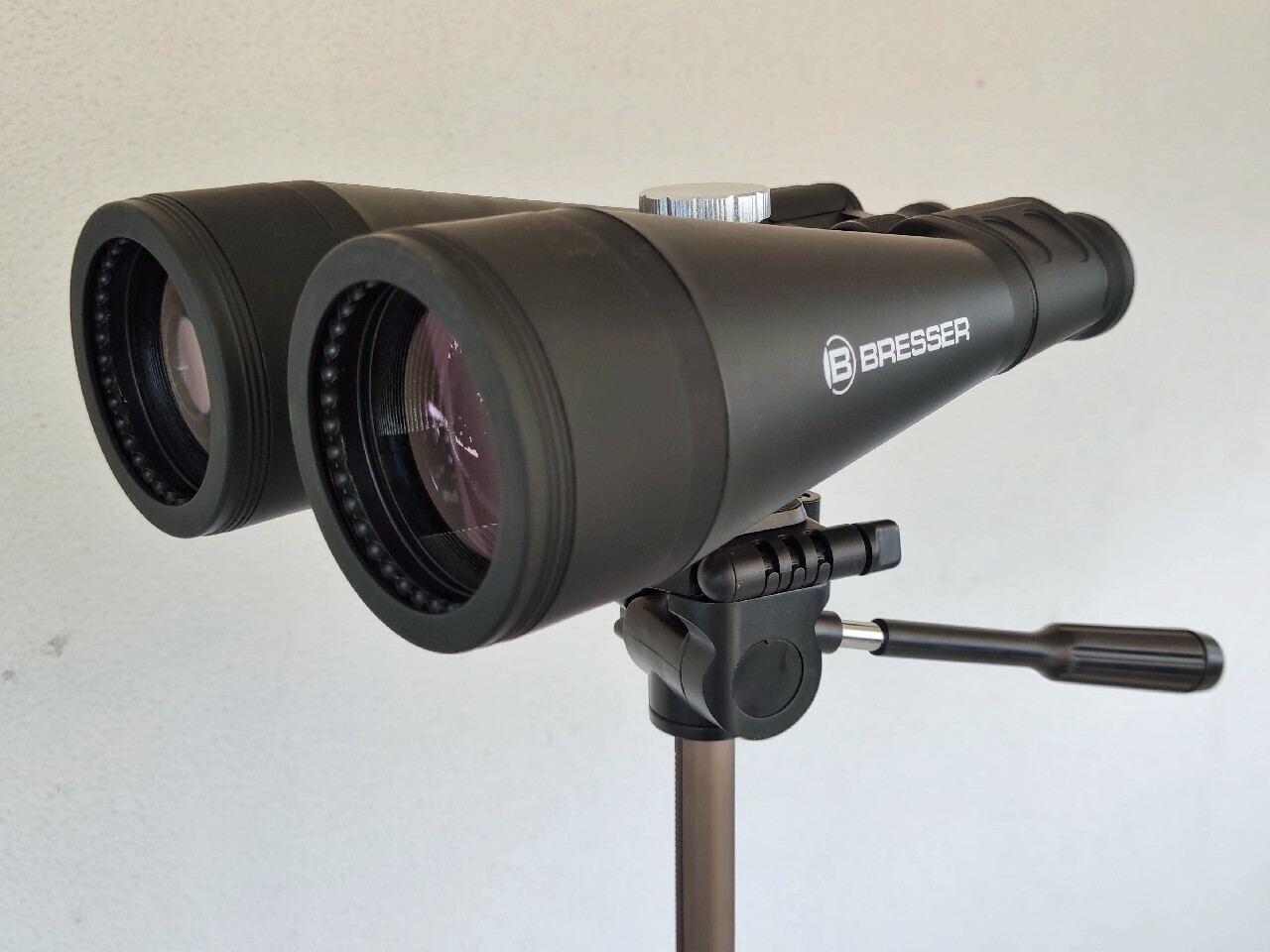
Bresser Binoculars Spezial Astro 20x80mm

Key features:

  • Astronomical/long-distance observations
  • Excellent light-gathering ability
  • On a tripod with standard 1/4" connection
  • With carrying case
See full description
  • Weight 2100 gr
  • See all
170 00
Delivery Wed, 24 Jun - Fri, 26 Jun
14,00 €   shipping cost
Sent from Greece
From SeaLandAir
Greece
1 piece
See Hunting & Shooting Gear on the page of SeaLandAir

Description

Description

Thanks to the high-quality BaK-4 glass with fully multi-coated coating and the extremely large diameter of the lenses, the BRESSER Spezial-Astro 20x80 Porro Binoculars offer bright and clear images from edge to edge. Their high magnification of 20x makes them exceptionally suitable not only for observing astronomical objects but also for observing distant terrestrial targets and natural studies. Their optical design and coatings effectively reduce light dispersion and the "ghosting" effect, thus ensuring a clear and pleasant observation experience.

The foldable rubber eyecups allow eyeglass wearers to make the most of the wide field of view that these binoculars offer.

With the tripod thread integrated into the sturdy central support column, the BRESSER Spezial-Astro 20x80 Porro Binoculars can be mounted directly onto any suitable camera tripod.

FEATURES
  • Binoculars for astronomical and distant observations
  • Excellent light-gathering capability
  • Can be directly mounted onto tripods with standard 1/4" connectors
WHAT'S INCLUDED
  • Binoculars
  • Carrying case

Features

  • Thanks to the high-quality BaK-4 glass with fully multi-coated optics and the extremely large lens diameter, the BRESSER Spezial-Astro 20x80 Porro binoculars offer bright and clear images from edge to edge.
  • Their high 20x magnification makes them extremely suitable not only for observing astronomical objects but also for observing distant terrestrial targets and nature study. 
  • Their optical design and coatings effectively reduce light dispersion and the "ghosting" effect, thus ensuring a clear and pleasant observation experience.
  • The foldable rubber eyecups allow eyeglass wearers to make the most of the wide field of view offered by these binoculars.
  • With the tripod thread integrated into the strong central support column, the BRESSER Spezial-Astro 20x80 Porro Binoculars can be directly mounted on any suitable camera tripod.


Content

  • Binoculars
  • Carrying case

Manufacturer

See full description

Specifications

Specifications

Product Details

Waterproof
No
Colour
Black
Type
Analog
Usage
Sky Observation
Night Vision
No
with Camera
No
Image Stabilization
No
Distance Measurement
No
with Compass
No
Weight
2100 gr
Internal Memory
No

Optical Characteristics

Prism Type
Porro
Magnification
20 x
Lens Diameter
80 mm
Field of View
56 m

Contents

Contains
Carrying Case, Tripod Adapter

Important information

Specifications are collected from official manufacturer websites. Please verify the specifications before proceeding with your final purchase. If you notice any problem you can report it here.

See all specifications

Reviews (5)

Reviews

  1. 4
  2. 4 stars
    0
  3. 3 stars
    0
  4. 1
  5. 1 star
    0
Review this product

Reviews photos

Reviews photos
Reviews photos
Reviews photos
Reviews photos
Reviews photos
Reviews photos

Reviews by our members

  • Konstantinos_K4121
    5
    8 out of 8 members found this review helpful

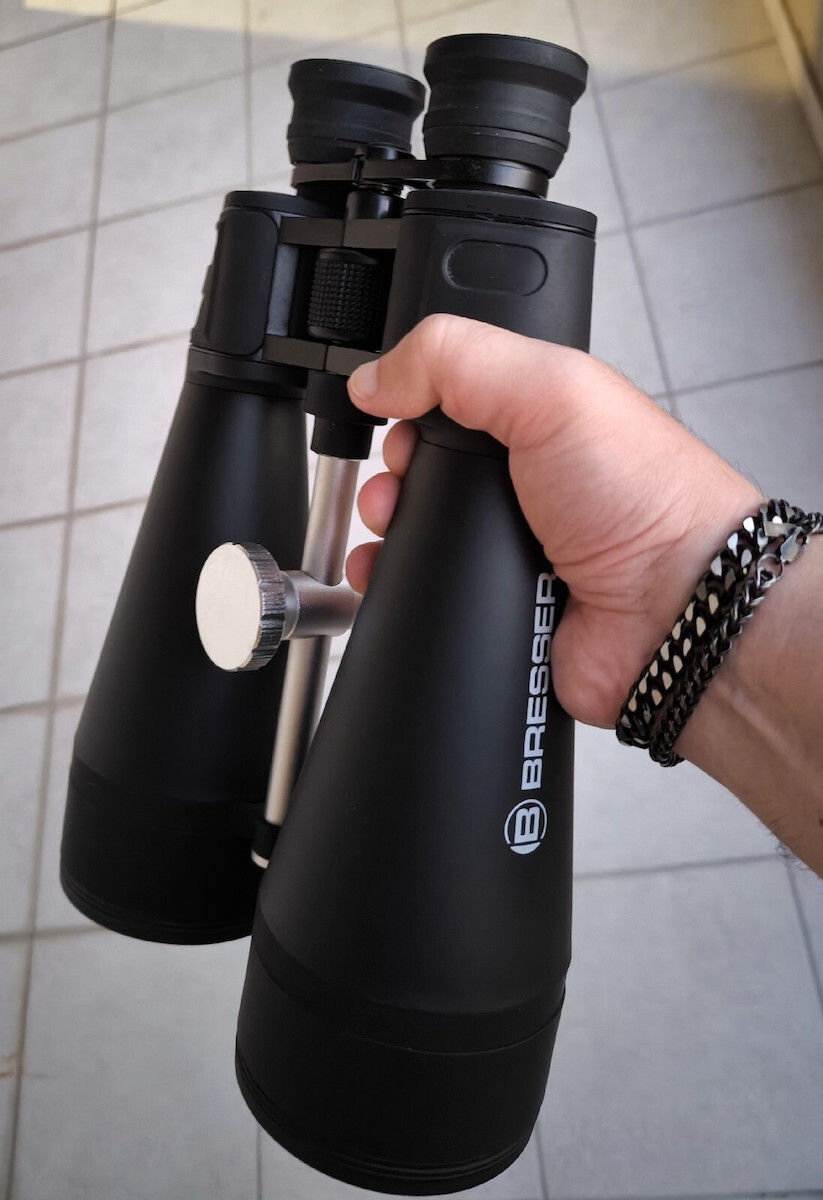
    These particular binoculars are for special purposes. They are not the kind of binoculars you hang around your neck for a trip; they are cumbersome due to their size and weight. They are intended for use in dark environments or in low light with the use of a stable tripod.

    There is a general rule for binoculars regarding the ratio of magnification to the diameter of the objective lenses; this ratio should be 1:4. Anything less will give a relatively dark image, while if the ratio is higher, the image will be very bright. For example, if the magnification is 10X, the lenses should have a diameter of 40mm. In these particular binoculars, the ratio is ideal (1:4), but because the objective lenses are very large and the glass is not premium, they provide a brighter image in daylight environments, and for this reason, a slight chromatic aberration may be observed. However, in a nighttime environment (sky observation), the bright image is an advantage.

    For €170, the binoculars are very good. Do not expect Swarovski quality at this price. Even Nikon binoculars (a top manufacturer in the field of optics) at this price show chromatic aberration. Whatever a pair of binoculars up to about €200 will give you, these will give you as well.

    Translated from Greek ·
    Did you find this review helpful?
  • PanagiotisDr.
    2
    7 out of 9 members found this review helpful

    I got them for €120. For this particular price and intended use, they are relatively decent binoculars. As the name suggests, they are made for astronomical use; otherwise, one could find much smaller, lighter, and more practical binoculars with smaller diameter lenses but the same magnification. In sunlight, you won’t notice any difference anyway. They definitely need a tripod, both because of their weight—close to two kilos—and because of the magnification. At night, they are excellent; indeed, they are very bright and not only will you see the craters and mountains of the moon, but from a dark sky, you will comfortably see dozens and perhaps hundreds of nebulae, galaxies, clusters, etc.

    A note here: on the Moon and the planets, because the optics are poor and have a very serious problem with chromatic aberration, you will see altered and annoying colors at the edges, so don’t expect a perfect image. The system for mounting them on the tripod is entirely metallic, very stable, and extremely practical—I suspect from some aluminum alloy. I don’t know why another review mentions it’s plastic. The build quality is rather average, with the focusing system being a bit stiff and often requiring quite a bit of fiddling to get both lenses focused exactly.

    During daytime observation, the reason for their low price becomes clear: chromatic aberration is very obvious, and the lenses focus sharply only in the center, as the peripheral image has very serious issues with coma error and rolling ball effect. You will get a clear image exclusively in about 20-25% of the center of the image, and as you approach the edges, the image is, to put it mildly, awful. It also becomes very apparent that one lens does not focus exactly the same as the other, so I constantly have to adjust the focus on the right eyepiece every time I focus at a different distance.

    If you’re looking for cheap astronomical binoculars with high magnification to learn, for example, the sky, but you absolutely can’t go for something better and more expensive like the Celestron Skymaster, then with a heavy heart, get these. You’ll see exactly the same things you would with more expensive 20x80 binoculars, but with slightly lower image quality—something that, if you’re a beginner and have no experience with similar optics, probably won’t bother you much. If I had known beforehand that their optics were so poor, I would have spent a bit more and probably gone for the Skymaster.

    For those looking for binoculars for daytime observation, definitely stay away; these are among the worst and most tiring binoculars I’ve ever tried—not because of the weight, but because of their lenses. In daylight, all the optical problems become apparent, and they look like binoculars you bought at the local fair. The two stars are for nighttime observation; if I were rating them for daytime observation, they wouldn’t get any stars at all.

    P.S. My pair, right out of the box, aside from the other optical issues, also needed collimation! Because one eye was looking one way and the other another, so that’s an extra risk—if you don’t know how to fix it, you’ll have to send them back immediately.
    In general, these binoculars are not something you would get to have a "good" pair of binoculars that will last you, but something between a toy from Jumbo and cheap branded equipment that we use for practical learning and then after a while move on to something more serious.
    Unfortunately, Bresser confirms once again that it not only manufactures cheap products for the masses but sometimes also makes cheap fairground products that should normally be sold in bulk from a basket "by the kilo"...
    They are so bad that I am even ashamed to list them for sale, I really wonder with what audacity Bresser printed its logo on the side and sells them to people!

    Translated from Greek ·
    Did you find this review helpful?
  • Kon_K6014
    5
    17 out of 17 members found this review helpful

    Bresser 20X80 binoculars, which are mainly known for the telescopes they manufacture. These are large and heavy binoculars, and the use of a tripod is essential, especially for observations that last for hours.
    The build quality is nothing special, they are mainly made of rubber and plastic (even the adapter for mounting on a tripod is plastic). They have done what they could to keep the cost and weight low. They are not waterproof, but generally, you should avoid getting your binoculars wet even if they are waterproof because water leaves stains and damages the coatings on the lenses.
    The image quality is very clear and with sufficient sharpness, I did not see any ghosting or distortion anywhere, and the focus is easy and accurate. If the atmosphere is clear, I can distinguish people at a distance of 10 km! The focus starts at a distance of about 20-25 m.
    In the same category as these are the Konus Giant and the Celestron Skymaster. Both are noticeably more expensive. I cannot express an opinion on the Konus because I have not tried them. I tried the Celestron and found no difference in image quality or focus. I keep a reservation because these types of binoculars are used for stargazing, maybe the Celestron performs slightly better in dark environments. I am not into that sport; I got them for terrestrial use and found no reason to spend an additional €80 for the exact same result.
    I am satisfied and recommend them. If the budget is limited, get them and you won't regret it. Otherwise, you can also look at the others I mentioned.

    Translated from Greek ·
    Did you find this review helpful?
  • Verified purchase

  • Verified purchase

  • These particular binoculars are for special purposes. They are not the kind of binoculars you hang around your neck for a trip; they are cumbersome due to their size and weight. They are intended for use in dark environments or in low light with the use of a stable tripod.

    There is a general rule for binoculars regarding the ratio of magnification to the diameter of the objective lenses; this ratio should be 1:4. Anything less will give a relatively dark image, while if the ratio is higher, the image will be very bright. For example, if the magnification is 10X, the lenses should have a diameter of 40mm. In these particular binoculars, the ratio is ideal (1:4), but because the objective lenses are very large and the glass is not premium, they provide a brighter image in daylight environments, and for this reason, a slight chromatic aberration may be observed. However, in a nighttime environment (sky observation), the bright image is an advantage.

    For €170, the binoculars are very good. Do not expect Swarovski quality at this price. Even Nikon binoculars (a top manufacturer in the field of optics) at this price show chromatic aberration. Whatever a pair of binoculars up to about €200 will give you, these will give you as well.

    Translated from Greek ·
    8
  • I got them for €120. For this particular price and intended use, they are relatively decent binoculars. As the name suggests, they are made for astronomical use; otherwise, one could find much smaller, lighter, and more practical binoculars with smaller diameter lenses but the same magnification. In sunlight, you won’t notice any difference anyway. They definitely need a tripod, both because of their weight—close to two kilos—and because of the magnification. At night, they are excellent; indeed, they are very bright and not only will you see the craters and mountains of the moon, but from a dark sky, you will comfortably see dozens and perhaps hundreds of nebulae, galaxies, clusters, etc.

    A note here: on the Moon and the planets, because the optics are poor and have a very serious problem with chromatic aberration, you will see altered and annoying colors at the edges, so don’t expect a perfect image. The system for mounting them on the tripod is entirely metallic, very stable, and extremely practical—I suspect from some aluminum alloy. I don’t know why another review mentions it’s plastic. The build quality is rather average, with the focusing system being a bit stiff and often requiring quite a bit of fiddling to get both lenses focused exactly.

    During daytime observation, the reason for their low price becomes clear: chromatic aberration is very obvious, and the lenses focus sharply only in the center, as the peripheral image has very serious issues with coma error and rolling ball effect. You will get a clear image exclusively in about 20-25% of the center of the image, and as you approach the edges, the image is, to put it mildly, awful. It also becomes very apparent that one lens does not focus exactly the same as the other, so I constantly have to adjust the focus on the right eyepiece every time I focus at a different distance.

    If you’re looking for cheap astronomical binoculars with high magnification to learn, for example, the sky, but you absolutely can’t go for something better and more expensive like the Celestron Skymaster, then with a heavy heart, get these. You’ll see exactly the same things you would with more expensive 20x80 binoculars, but with slightly lower image quality—something that, if you’re a beginner and have no experience with similar optics, probably won’t bother you much. If I had known beforehand that their optics were so poor, I would have spent a bit more and probably gone for the Skymaster.

    For those looking for binoculars for daytime observation, definitely stay away; these are among the worst and most tiring binoculars I’ve ever tried—not because of the weight, but because of their lenses. In daylight, all the optical problems become apparent, and they look like binoculars you bought at the local fair. The two stars are for nighttime observation; if I were rating them for daytime observation, they wouldn’t get any stars at all.

    P.S. My pair, right out of the box, aside from the other optical issues, also needed collimation! Because one eye was looking one way and the other another, so that’s an extra risk—if you don’t know how to fix it, you’ll have to send them back immediately.
    In general, these binoculars are not something you would get to have a "good" pair of binoculars that will last you, but something between a toy from Jumbo and cheap branded equipment that we use for practical learning and then after a while move on to something more serious.
    Unfortunately, Bresser confirms once again that it not only manufactures cheap products for the masses but sometimes also makes cheap fairground products that should normally be sold in bulk from a basket "by the kilo"...
    They are so bad that I am even ashamed to list them for sale, I really wonder with what audacity Bresser printed its logo on the side and sells them to people!

    Translated from Greek ·
    7
  • Bresser 20X80 binoculars, which are mainly known for the telescopes they manufacture. These are large and heavy binoculars, and the use of a tripod is essential, especially for observations that last for hours.
    The build quality is nothing special, they are mainly made of rubber and plastic (even the adapter for mounting on a tripod is plastic). They have done what they could to keep the cost and weight low. They are not waterproof, but generally, you should avoid getting your binoculars wet even if they are waterproof because water leaves stains and damages the coatings on the lenses.
    The image quality is very clear and with sufficient sharpness, I did not see any ghosting or distortion anywhere, and the focus is easy and accurate. If the atmosphere is clear, I can distinguish people at a distance of 10 km! The focus starts at a distance of about 20-25 m.
    In the same category as these are the Konus Giant and the Celestron Skymaster. Both are noticeably more expensive. I cannot express an opinion on the Konus because I have not tried them. I tried the Celestron and found no difference in image quality or focus. I keep a reservation because these types of binoculars are used for stargazing, maybe the Celestron performs slightly better in dark environments. I am not into that sport; I got them for terrestrial use and found no reason to spend an additional €80 for the exact same result.
    I am satisfied and recommend them. If the budget is limited, get them and you won't regret it. Otherwise, you can also look at the others I mentioned.

    Translated from Greek ·
    17
  • 0
  • 0
  • See all

Description & Specifications

Thanks to the high-quality BaK-4 glass with fully multi-coated coating and the extremely large diameter of the lenses, the BRESSER Spezial-Astro 20x80 Porro Binoculars offer bright and clear images from edge to edge. Their high magnification of 20x makes them exceptionally suitable not only for observing astronomical objects but also for observing distant terrestrial targets and natural studies. Their optical design and coatings effectively reduce light dispersion and the "ghosting" effect, thus ensuring a clear and pleasant observation experience.

The foldable rubber eyecups allow eyeglass wearers to make the most of the wide field of view that these binoculars offer.

With the tripod thread integrated into the sturdy central support column, the BRESSER Spezial-Astro 20x80 Porro Binoculars can be mounted directly onto any suitable camera tripod.

FEATURES
  • Binoculars for astronomical and distant observations
  • Excellent light-gathering capability
  • Can be directly mounted onto tripods with standard 1/4" connectors
WHAT'S INCLUDED
  • Binoculars
  • Carrying case

Features

  • Thanks to the high-quality BaK-4 glass with fully multi-coated optics and the extremely large lens diameter, the BRESSER Spezial-Astro 20x80 Porro binoculars offer bright and clear images from edge to edge.
  • Their high 20x magnification makes them extremely suitable not only for observing astronomical objects but also for observing distant terrestrial targets and nature study. 
  • Their optical design and coatings effectively reduce light dispersion and the "ghosting" effect, thus ensuring a clear and pleasant observation experience.
  • The foldable rubber eyecups allow eyeglass wearers to make the most of the wide field of view offered by these binoculars.
  • With the tripod thread integrated into the strong central support column, the BRESSER Spezial-Astro 20x80 Porro Binoculars can be directly mounted on any suitable camera tripod.


Content

  • Binoculars
  • Carrying case

Manufacturer

Product Details

Waterproof
No
Colour
Black
Type
Analog
Usage
Sky Observation
Night Vision
No
with Camera
No
Image Stabilization
No
Distance Measurement
No
with Compass
No
Weight
2100 gr
Internal Memory
No

Optical Characteristics

Prism Type
Porro
Magnification
20 x
Lens Diameter
80 mm
Field of View
56 m

Contents

Contains
Carrying Case, Tripod Adapter

Important information

Specifications are collected from official manufacturer websites. Please verify the specifications before proceeding with your final purchase. If you notice any problem you can report it here.

Reviews (5)

  1. 4
  2. 4 stars
    0
  3. 3 stars
    0
  4. 1
  5. 1 star
    0
Review this product

Reviews photos

Reviews photos
Reviews photos
Reviews photos
Reviews photos
Reviews photos
Reviews photos

Reviews by our members

  • Konstantinos_K4121
    5
    8 out of 8 members found this review helpful

    These particular binoculars are for special purposes. They are not the kind of binoculars you hang around your neck for a trip; they are cumbersome due to their size and weight. They are intended for use in dark environments or in low light with the use of a stable tripod.

    There is a general rule for binoculars regarding the ratio of magnification to the diameter of the objective lenses; this ratio should be 1:4. Anything less will give a relatively dark image, while if the ratio is higher, the image will be very bright. For example, if the magnification is 10X, the lenses should have a diameter of 40mm. In these particular binoculars, the ratio is ideal (1:4), but because the objective lenses are very large and the glass is not premium, they provide a brighter image in daylight environments, and for this reason, a slight chromatic aberration may be observed. However, in a nighttime environment (sky observation), the bright image is an advantage.

    For €170, the binoculars are very good. Do not expect Swarovski quality at this price. Even Nikon binoculars (a top manufacturer in the field of optics) at this price show chromatic aberration. Whatever a pair of binoculars up to about €200 will give you, these will give you as well.

    Translated from Greek ·
    Did you find this review helpful?
  • PanagiotisDr.
    2
    7 out of 9 members found this review helpful

    I got them for €120. For this particular price and intended use, they are relatively decent binoculars. As the name suggests, they are made for astronomical use; otherwise, one could find much smaller, lighter, and more practical binoculars with smaller diameter lenses but the same magnification. In sunlight, you won’t notice any difference anyway. They definitely need a tripod, both because of their weight—close to two kilos—and because of the magnification. At night, they are excellent; indeed, they are very bright and not only will you see the craters and mountains of the moon, but from a dark sky, you will comfortably see dozens and perhaps hundreds of nebulae, galaxies, clusters, etc.

    A note here: on the Moon and the planets, because the optics are poor and have a very serious problem with chromatic aberration, you will see altered and annoying colors at the edges, so don’t expect a perfect image. The system for mounting them on the tripod is entirely metallic, very stable, and extremely practical—I suspect from some aluminum alloy. I don’t know why another review mentions it’s plastic. The build quality is rather average, with the focusing system being a bit stiff and often requiring quite a bit of fiddling to get both lenses focused exactly.

    During daytime observation, the reason for their low price becomes clear: chromatic aberration is very obvious, and the lenses focus sharply only in the center, as the peripheral image has very serious issues with coma error and rolling ball effect. You will get a clear image exclusively in about 20-25% of the center of the image, and as you approach the edges, the image is, to put it mildly, awful. It also becomes very apparent that one lens does not focus exactly the same as the other, so I constantly have to adjust the focus on the right eyepiece every time I focus at a different distance.

    If you’re looking for cheap astronomical binoculars with high magnification to learn, for example, the sky, but you absolutely can’t go for something better and more expensive like the Celestron Skymaster, then with a heavy heart, get these. You’ll see exactly the same things you would with more expensive 20x80 binoculars, but with slightly lower image quality—something that, if you’re a beginner and have no experience with similar optics, probably won’t bother you much. If I had known beforehand that their optics were so poor, I would have spent a bit more and probably gone for the Skymaster.

    For those looking for binoculars for daytime observation, definitely stay away; these are among the worst and most tiring binoculars I’ve ever tried—not because of the weight, but because of their lenses. In daylight, all the optical problems become apparent, and they look like binoculars you bought at the local fair. The two stars are for nighttime observation; if I were rating them for daytime observation, they wouldn’t get any stars at all.

    P.S. My pair, right out of the box, aside from the other optical issues, also needed collimation! Because one eye was looking one way and the other another, so that’s an extra risk—if you don’t know how to fix it, you’ll have to send them back immediately.
    In general, these binoculars are not something you would get to have a "good" pair of binoculars that will last you, but something between a toy from Jumbo and cheap branded equipment that we use for practical learning and then after a while move on to something more serious.
    Unfortunately, Bresser confirms once again that it not only manufactures cheap products for the masses but sometimes also makes cheap fairground products that should normally be sold in bulk from a basket "by the kilo"...
    They are so bad that I am even ashamed to list them for sale, I really wonder with what audacity Bresser printed its logo on the side and sells them to people!

    Translated from Greek ·
    Did you find this review helpful?
  • Kon_K6014
    5
    17 out of 17 members found this review helpful

    Bresser 20X80 binoculars, which are mainly known for the telescopes they manufacture. These are large and heavy binoculars, and the use of a tripod is essential, especially for observations that last for hours.
    The build quality is nothing special, they are mainly made of rubber and plastic (even the adapter for mounting on a tripod is plastic). They have done what they could to keep the cost and weight low. They are not waterproof, but generally, you should avoid getting your binoculars wet even if they are waterproof because water leaves stains and damages the coatings on the lenses.
    The image quality is very clear and with sufficient sharpness, I did not see any ghosting or distortion anywhere, and the focus is easy and accurate. If the atmosphere is clear, I can distinguish people at a distance of 10 km! The focus starts at a distance of about 20-25 m.
    In the same category as these are the Konus Giant and the Celestron Skymaster. Both are noticeably more expensive. I cannot express an opinion on the Konus because I have not tried them. I tried the Celestron and found no difference in image quality or focus. I keep a reservation because these types of binoculars are used for stargazing, maybe the Celestron performs slightly better in dark environments. I am not into that sport; I got them for terrestrial use and found no reason to spend an additional €80 for the exact same result.
    I am satisfied and recommend them. If the budget is limited, get them and you won't regret it. Otherwise, you can also look at the others I mentioned.

    Translated from Greek ·
    Did you find this review helpful?
  • Verified purchase

  • Verified purchase

  • These particular binoculars are for special purposes. They are not the kind of binoculars you hang around your neck for a trip; they are cumbersome due to their size and weight. They are intended for use in dark environments or in low light with the use of a stable tripod.

    There is a general rule for binoculars regarding the ratio of magnification to the diameter of the objective lenses; this ratio should be 1:4. Anything less will give a relatively dark image, while if the ratio is higher, the image will be very bright. For example, if the magnification is 10X, the lenses should have a diameter of 40mm. In these particular binoculars, the ratio is ideal (1:4), but because the objective lenses are very large and the glass is not premium, they provide a brighter image in daylight environments, and for this reason, a slight chromatic aberration may be observed. However, in a nighttime environment (sky observation), the bright image is an advantage.

    For €170, the binoculars are very good. Do not expect Swarovski quality at this price. Even Nikon binoculars (a top manufacturer in the field of optics) at this price show chromatic aberration. Whatever a pair of binoculars up to about €200 will give you, these will give you as well.

    Translated from Greek ·
    8
  • I got them for €120. For this particular price and intended use, they are relatively decent binoculars. As the name suggests, they are made for astronomical use; otherwise, one could find much smaller, lighter, and more practical binoculars with smaller diameter lenses but the same magnification. In sunlight, you won’t notice any difference anyway. They definitely need a tripod, both because of their weight—close to two kilos—and because of the magnification. At night, they are excellent; indeed, they are very bright and not only will you see the craters and mountains of the moon, but from a dark sky, you will comfortably see dozens and perhaps hundreds of nebulae, galaxies, clusters, etc.

    A note here: on the Moon and the planets, because the optics are poor and have a very serious problem with chromatic aberration, you will see altered and annoying colors at the edges, so don’t expect a perfect image. The system for mounting them on the tripod is entirely metallic, very stable, and extremely practical—I suspect from some aluminum alloy. I don’t know why another review mentions it’s plastic. The build quality is rather average, with the focusing system being a bit stiff and often requiring quite a bit of fiddling to get both lenses focused exactly.

    During daytime observation, the reason for their low price becomes clear: chromatic aberration is very obvious, and the lenses focus sharply only in the center, as the peripheral image has very serious issues with coma error and rolling ball effect. You will get a clear image exclusively in about 20-25% of the center of the image, and as you approach the edges, the image is, to put it mildly, awful. It also becomes very apparent that one lens does not focus exactly the same as the other, so I constantly have to adjust the focus on the right eyepiece every time I focus at a different distance.

    If you’re looking for cheap astronomical binoculars with high magnification to learn, for example, the sky, but you absolutely can’t go for something better and more expensive like the Celestron Skymaster, then with a heavy heart, get these. You’ll see exactly the same things you would with more expensive 20x80 binoculars, but with slightly lower image quality—something that, if you’re a beginner and have no experience with similar optics, probably won’t bother you much. If I had known beforehand that their optics were so poor, I would have spent a bit more and probably gone for the Skymaster.

    For those looking for binoculars for daytime observation, definitely stay away; these are among the worst and most tiring binoculars I’ve ever tried—not because of the weight, but because of their lenses. In daylight, all the optical problems become apparent, and they look like binoculars you bought at the local fair. The two stars are for nighttime observation; if I were rating them for daytime observation, they wouldn’t get any stars at all.

    P.S. My pair, right out of the box, aside from the other optical issues, also needed collimation! Because one eye was looking one way and the other another, so that’s an extra risk—if you don’t know how to fix it, you’ll have to send them back immediately.
    In general, these binoculars are not something you would get to have a "good" pair of binoculars that will last you, but something between a toy from Jumbo and cheap branded equipment that we use for practical learning and then after a while move on to something more serious.
    Unfortunately, Bresser confirms once again that it not only manufactures cheap products for the masses but sometimes also makes cheap fairground products that should normally be sold in bulk from a basket "by the kilo"...
    They are so bad that I am even ashamed to list them for sale, I really wonder with what audacity Bresser printed its logo on the side and sells them to people!

    Translated from Greek ·
    7
  • Bresser 20X80 binoculars, which are mainly known for the telescopes they manufacture. These are large and heavy binoculars, and the use of a tripod is essential, especially for observations that last for hours.
    The build quality is nothing special, they are mainly made of rubber and plastic (even the adapter for mounting on a tripod is plastic). They have done what they could to keep the cost and weight low. They are not waterproof, but generally, you should avoid getting your binoculars wet even if they are waterproof because water leaves stains and damages the coatings on the lenses.
    The image quality is very clear and with sufficient sharpness, I did not see any ghosting or distortion anywhere, and the focus is easy and accurate. If the atmosphere is clear, I can distinguish people at a distance of 10 km! The focus starts at a distance of about 20-25 m.
    In the same category as these are the Konus Giant and the Celestron Skymaster. Both are noticeably more expensive. I cannot express an opinion on the Konus because I have not tried them. I tried the Celestron and found no difference in image quality or focus. I keep a reservation because these types of binoculars are used for stargazing, maybe the Celestron performs slightly better in dark environments. I am not into that sport; I got them for terrestrial use and found no reason to spend an additional €80 for the exact same result.
    I am satisfied and recommend them. If the budget is limited, get them and you won't regret it. Otherwise, you can also look at the others I mentioned.

    Translated from Greek ·
    17
  • 0
  • 0
  • See all
170,00 €
14,00 €   shipping cost