Platon
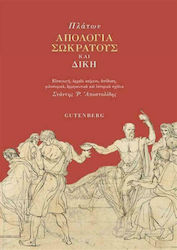
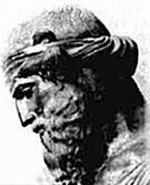
Greek philosopher and author (427-347 BC). He was born in Athens to noble parents. His father, Ariston, claimed descent from the lineage of Codrus, and his mother, Perictione, from Solon. He had two brothers, Adeimantus and Glaucon. His first name was Aristocles. He was later named Plato for his broad chest and wide forehead. As a young man, he engaged in poetry but quickly turned to philosophy. He was 20 years old when he met Socrates and stayed with him for eight years, until the great teacher's death in 399 BC. The unjust death of Socrates convinced him that Athenian democracy had significant flaws, and he took on the role of a social reformer. After Socrates' execution, he briefly took refuge in Megara with his fellow student Euclid. He then returned to Athens, where he spent 10 years writing philosophical works, which bear the mark of Socratic philosophy. Subsequently, he traveled to Egypt and Cyrene, where he associated with the mathematician Theodorus, and finally to Tarentum in Italy, where he met the Pythagoreans, whose philosophical thought decisively influenced him. He then went to Sicily. At the court of Dionysius I, the king of Syracuse, he befriended the king's brother-in-law Dion. However, this friendship aroused Dionysius's suspicions of conspiracy, leading to Plato's expulsion from Sicily. In Aegina, he was at risk of being sold into slavery, but his Cyrenean friend Anniceris ransomed him. Returning to Athens, he founded his philosophical school, the Academy. However, the attempt by the two friends to convert the new ruler Dionysius II to their ideas failed. For the third time, he came to the court of Syracuse in 361 BC, intending to reconcile Dion with Dionysius. This time, his life was in danger, but he was saved by the intervention of the Pythagorean Archytas. Dion, however, was not spared and was assassinated in 353 BC. Thus, Plato lost the person on whom he had pinned his hopes for the implementation of his political ideas. From then on, until his death, Plato devoted himself to teaching and writing philosophical works. Plato's works number 36, and all, except for the "Apology," are in dialogue form. In his writing, the philosopher emulated Socrates' method of teaching through dialogue. His dialogues are titled with the name of one of the interlocutors, such as "Timaeus," "Gorgias," "Protagoras," etc. Only three dialogues, the "Symposium," the "Republic," and the "Laws," are titled based on their content. In all the dialogues, Socrates directs the discussion. In the earlier dialogues, he maintains the image of the real Socrates, while in the later ones, the teacher's persona conceals that of the student himself. The entirety of Plato's work is divided into three periods based on chronological order:
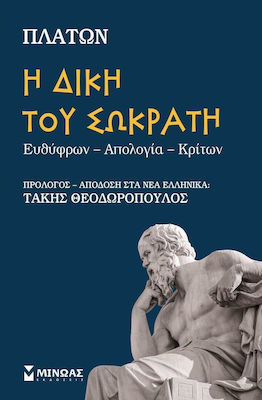
a) Period of Youth (400-387 BC): This includes: Apology, Crito, Charmides, Protagoras, Laches, Euthyphro, Greater Hippias, Lesser Hippias, Ion, Lysis.
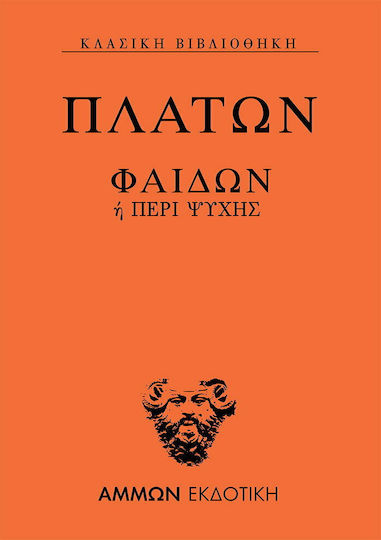
b) Period of Maturity (386-367 BC): This includes: Menexenus, Cratylus, Euthydemus, Gorgias, Meno, Parmenides, Phaedo, Phaedrus, Republic, Symposium, Theaetetus.
c) Period of Old Age (366-348 BC): This includes: Sophist, Statesman, Philebus, Critias, Timaeus, Laws, 7th Letter.