Gottfried Wilhelm Leibniz
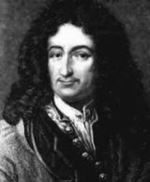
Gottfried Wilhelm Leibniz (1646-1716). Born in Leipzig and passed away in Hanover, he was one of the most significant universal minds in global culture. He studied law and initially, rejecting an academic career, worked in the service of the prince in Mainz and from 1776 as a librarian at the Court of the Duke of Hanover. During his stay in Paris and London from 1672-1676 as a diplomatic representative, he studied the mathematics and natural sciences of his time.
Leibniz formulated philosophical theories aimed at reconciling religion with philosophy and the natural sciences, and more generally, at resolving philosophical contradictions. For example, a cause cannot have the same nature as the action it causes, so God is outside the causal dependency of cause and action, not as the first cause of this chain. He formulated significant elements of the Theory of Causality, inaugurating the history of Mathematical Logic, which was later formulated in a strict form by Russell. Leibniz's complete works include approximately 15,000 letters exchanged with prominent figures of his time and a large number of books and scientific publications. Throughout his career, he strove for the reunification of the Protestant and Catholic churches and for the dissemination of the positive sciences through the establishment of appropriate educational institutions.
In 1684, he published the "Principles of Differential Calculus," thus coming into conflict with Newton, who claimed the authorship of these ideas. In 1693, Leibniz introduced the concept of the determinant in mathematics and developed the binary system with the digits 0 and 1. Besides being a philosopher and mathematician, Leibniz was also a naturalist and technician. In 1673, he constructed a calculating machine, which is now housed in a technical museum in Germany.