Alkiviadis Giannopoulos

Alkiviadis Giannopoulos
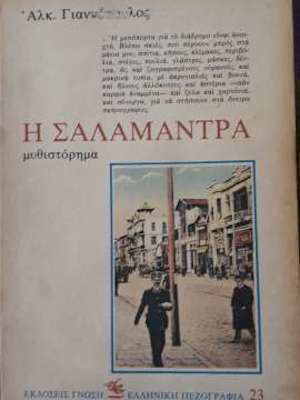
Alkiviadis Giannopoulos (1896-1981). Alkiviadis Giannopoulos was born in Athens, the son of Agesilaos Giannopoulos from Epirus and Maria - Eurydice née Spiliadi. His father was an economist and the director of Dimitrios Koromilas' newspaper Efimeris. In the literary world, he was primarily known for his introduction-manifesto of naturalism, which he wrote for the first Greek translation of Zola's Nana (by Kambouroglou). After his father's death, Alkiviadis, his mother, and his six siblings initially moved to Marseille and then to Milan. There, he completed Italian schooling and maintained his Greek language skills thanks to his sister Ioanna. In 1915, he enrolled in the Faculty of Physics and Mathematics at the Polytechnic University of Milan, where he came into contact with the Futurism movement, which influenced his early prose works in Italian. He corresponded with Marinetti and co-founded the magazine Frecia Futurista. He returned to Greece in 1917 to serve in the military and settled permanently in 1920 after the death of his mother and two siblings (he had briefly returned to Milan in 1919, where he interrupted his studies and worked at the Credito Italiano bank. During this time, he collaborated on the publication of the short-lived magazine Zibaldone). He was hired by the Bank of Greece and requested to work at the Thessaloniki branch. He collaborated with the magazine Macedonian Days, where he published the poem Sonetto and his first Greek prose work titled Heads in a Row (1932). His literary output during the Thessaloniki period was well-received by critics. In 1938, he was transferred to Piraeus, where he experienced the sorrow of his sister Ioanna's death, with whom he lived. In 1942, he married painter Georgia Terlidou. During the German occupation, he and his wife participated in the National Resistance and also fought through his writings. In 1953, he resigned from his position at the Bank and subsequently worked in the Studies Directorate of the Press Undersecretariat, where he was particularly involved in compiling the Greek Bibliography (1958-1968) in three languages. He was dismissed from this position by the dictatorial regime of Papadopoulos. He was awarded the First State Short Story Prize (1963 for the collection The Blind Man's Buff and 1974 for the Seven Imponderable Stories). He was a member of the Society of Greek Writers (from 1948) and its president (1976 until his death). He died at the age of eighty-five in Athens. Alkiviadis Giannopoulos' first official appearance in the field of modern Greek literature took place in 1932 with the publication of his short story Heads in a Row in the magazine Macedonian Letters. However, it should be noted that this story essentially marks the beginning of the second period of his literary career, as it was preceded by his Italian-language production, from which he retained many elements. His work is part of the modern literature of the Generation of the Thirties and is mainly characterized by anti-realistic writing, plot twists, the distinction between physical and psychological time, dreamlike elements, and existential anxiety. Notable works include The Forest with the Monkeys and his only novel titled The Salamander. He also engaged in playwriting, criticism, study, essay writing, and literary translation. For more biographical details on Alkiviadis Giannopoulos, see. Manolis Gialourakis, "Alkiviadis Giannopoulos," Great Encyclopedia of Modern Greek Literature 5. Athens, Hari Patsi, n.d., Kehagia - Lypourli A., "Alkiviadis Giannopoulos," World Biographical Dictionary 3. Athens, Ekdotiki Athinon, 1985 and Kehagia - Lypourli Aglaia, "Alkiviadis Giannopoulos," Interwar Prose: From the First to the Second World War (1914-1939) Vol. C, pp. 92-159. Athens, Sokolis, 1992. (Source: Archive of Greek Authors, EKEVI).
0
 Greek Fiction Books
Ανθολογία Ελληνικού Διηγήματος του 20ού Αιώνα
Collective Work, 2009 , Cover: Hard , Kastaniotis Editions
from24,86 € at 3 stores0